Key takeaways
- Google says, in its own words, that Maps rankings come down to relevance, distance, and prominence
- A profile that's unverified, suspended, duplicated, or filed under the wrong category won't rank no matter what you publish
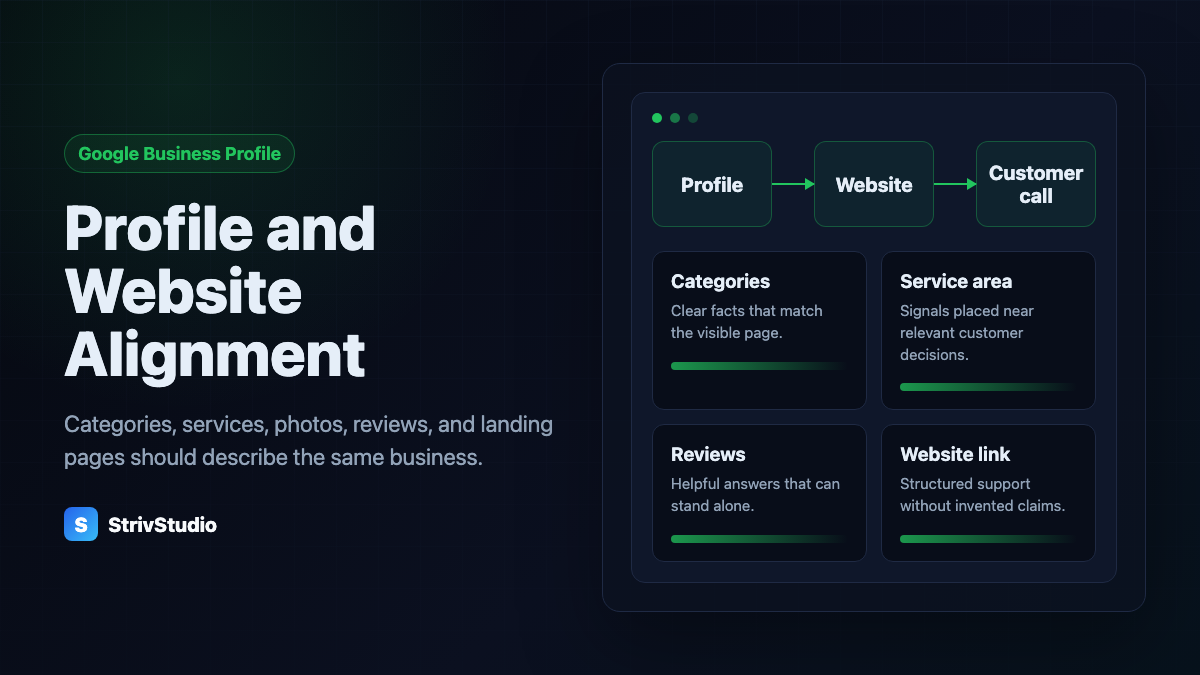
- Your website has to back up the same services, categories, service areas, and proof the profile shows
- You won't outrank a closer, better-known competitor for every search, and no amount of content changes distance
Short answer: If your business is not showing up on Google Maps, it's almost always one of a handful of things: a profile that isn't eligible or healthy, a poor match to what was searched, distance, competitors with more prominence, or business information that conflicts from one place to the next. Work out which one applies before you start fixing.
How Google ranks local results
Google's own guidance says local results are based mainly on relevance, distance, and prominence. That sentence matters more than most owners realize. They come looking for one technical fix, and the real problem is some mix of profile quality, where the business sits, how much proof it has, and who else is competing for the same searches.
Google describes relevance, distance, and prominence as the core local ranking factors. Accurate profile and website information can push relevance and prominence. Nothing on your website changes how far away the searcher is standing.
- Relevance: does your business clearly match what the person searched for?
- Distance: are you close enough, or does Google understand the area you serve?
- Prominence: do you have enough reviews, mentions, and proof compared with the businesses around you?
Your profile isn't eligible, verified, or healthy
Start here, always. If the profile is unverified, suspended, duplicated, or filed under a category that doesn't match the real business, nothing else you do will land. Ranking work on a broken profile is money spent on nothing.
Our Google Business Profile optimization work treats the profile and the website as one local visibility system, not two separate jobs.
Check these first:
- The profile is verified, and the owner or a manager can actually log in.
- The primary category matches the main service. Not the broadest one, and not the one you'd like to grow into.
- The business name is the real-world name, without keywords stuffed into it.
- The address or service-area setup follows Google's rules for your type of business.
- There's no duplicate profile competing with the real one.
Fix any of these before you add content. Content can't repair a profile that's ineligible, suspended, duplicated, or describing the wrong business.
Your services and categories are too vague
Home-service companies lose Maps visibility all the time because the profile and the site describe the business too broadly. "Contractor" means nothing to someone searching for emergency roof repair, drain cleaning, a furnace replacement, or post-construction cleanup.
List the real services on the profile. Then back each one up on the website with a page that says who it's for, where it's available, what the process looks like, and what proof stands behind it.
This is where local SEO for home service businesses connects directly to Maps. The profile fields are short. The website is where Google and customers get the rest of the story.
Your website and profile don't agree
Conflicting service areas, phone numbers, or business names across the profile, the site, and directory listings are a common problem, and an easy one to create by accident. Fix every material conflict so each public source describes the same business.
Put the profile next to the site and compare:
- Business name uses the same format.
- Phone number and contact path match.
- Every service on the profile has a page on the site.
- Hours and availability don't contradict each other.
- Service-area language is consistent and realistic.
- Photos, reviews, and proof match the actual business.
The point is for every public source to describe the same company. That's different from pasting one sentence everywhere.
You don't have enough prominence yet
Some businesses have a perfectly correct profile and still sit below competitors who are closer, a better match, or simply better known. Google says review count, ratings, and links feed into prominence, alongside other signals it doesn't fully disclose.
The ongoing work that helps:
- Ask happy customers for a real Google review once the job is done.
- Reply to reviews specifically and professionally.
- Add real photos: your people, your vehicles, finished work.
- Build service pages that answer the questions customers actually ask.
- Earn legitimate local mentions from partners, suppliers, directories, and community pages.
Don't buy reviews. Don't build doorway pages for cities you can't serve. Both are shortcuts that add risk and build nothing that lasts.
What to fix first
Work in this order:
- Confirm verification, category, service area, and business name are right.
- Clean up any conflicting name, phone, service, and hours details on the website.
- Build or improve the pages for the services that make you money.
- Add visible proof: reviews, photos, project examples, credentials, and your process.
- Set up a simple way to ask for a review after every completed job.
- Track which searches and locations still miss, then decide whether the gap is relevance, distance, or prominence.
That sequence covers profile health, consistent facts, useful content, proof, and measurement. It doesn't promise you a position. If you're still unsure whether the profile or the site is the weak link, this comparison explains what each one is for.
FAQ
Why is my business not showing up on Google Maps?
Usually one of these: the profile is ineligible, unverified, suspended, or duplicated; the category or business facts are wrong; the business has little prominence yet; or the search is happening outside the area Google thinks you serve.
Can a website help Google Maps rankings?
Yes, when it clearly matches the profile, explains your services and service areas, earns local links or mentions, and gives customers a real place to learn more.
Can I rank in cities where I don't have an address?
Sometimes, and it's harder. A service-area business can show the areas it covers, but Google still weighs distance and prominence. A stack of thin city pages won't get around that.