Key takeaways
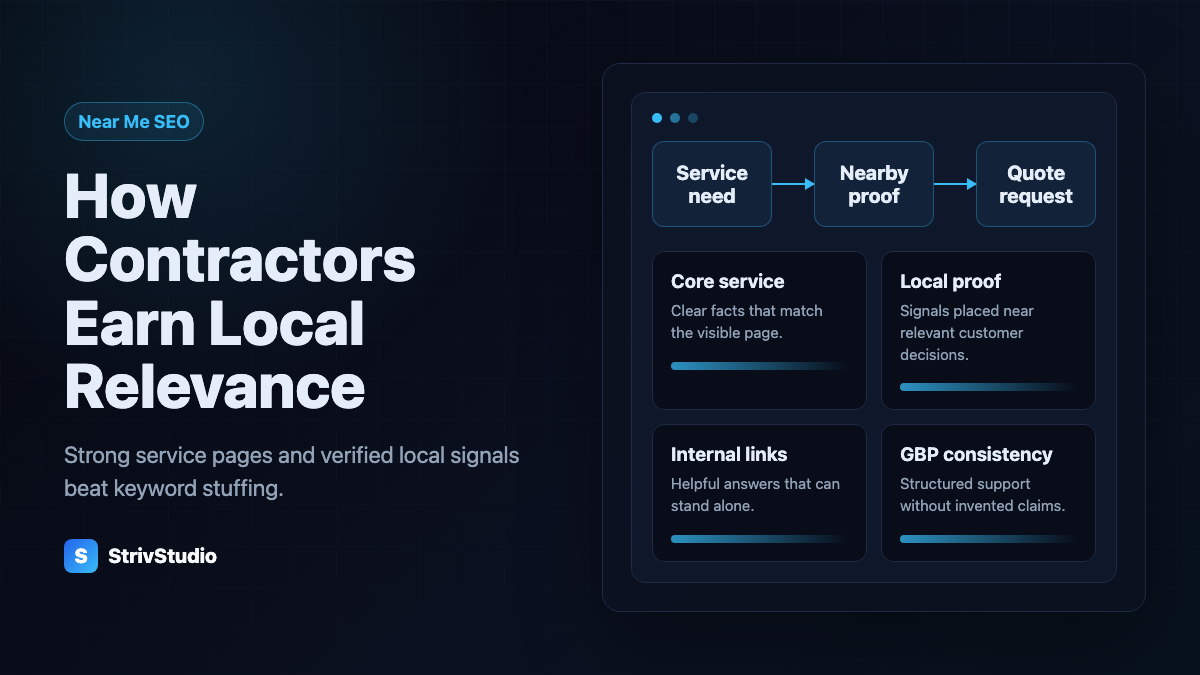
- Near me rankings come from relevance, distance, and prominence. Repeating the phrase adds none of them
- Build one real page per important service before you build a single city page
- A city page earns its place with local detail, proof, and a link back to the parent service. A name swap doesn't
- The Google Business Profile, your reviews and photos, and your site structure all have to tell the same story
Short answer: Contractors rank for near me searches on relevance, distance, prominence, a healthy Google profile, accurate coverage, and service pages that actually explain the work. Stuffing the phrase "near me" into your titles creates none of those signals and guarantees nothing.
Near me is location context, not magic text
When someone types "roofer near me" or "emergency plumber near me," Google already knows where they're standing. Forcing the words "near me" into every page title does nothing for you. Being the obvious match for that person's problem, in that person's area, does everything.
That match comes from the same signals that drive Maps and organic rankings: relevant services, accurate business facts, clear service areas, pages worth reading, customer proof, and how prominent you are in your market.
Build service pages before you chase city pages
Here's the usual mistake. A contractor publishes ten thin city pages before they have one solid service page. It's backwards, and it's expensive to undo.
A real contractor service page answers:
- What exact service do you provide?
- What problems does it solve?
- Who is the right customer?
- Where is it available?
- What proof backs you up?
- What happens after someone asks for a quote?
A roofing company needs a real roof repair page before it builds a page for every nearby town. A plumber needs a real emergency plumbing page before a dozen location variants of it.
Our contractor website design work starts with the first screen and the service structure, so someone arriving from search understands the offer and knows what to do next.
How to use city pages without doorway risk
City pages can work. Each one needs a reason to exist beyond the town name in the heading. A page that says what every other page says, with the location swapped, isn't an asset. It's the kind of page Google has a name for.
What makes a city page worth publishing:
- The specific services you offer in that town
- Neighborhoods, property types, or constraints that actually apply there
- Photos or examples from nearby jobs, when you have them
- FAQs that reflect what buyers in that area ask
- A clear link back to the parent service page
- A contact path that confirms you cover the area
If you can't fill a city page with real detail, don't publish it yet. Go back and make the parent service page better.
Your Google Business Profile has to tell the same story
Near me visibility leans heavily on the Google Business Profile. The site and the profile should back each other up.
Check the alignment:
- The primary category matches the service that makes the most money.
- The services listed on the profile match pages on the site.
- The website link lands on a page that explains the offer fast.
- Photos show real work, real people, real vehicles and equipment.
- Reviews are genuine and never scripted to include keywords.
If the profile says "general contractor" and the site pushes kitchen remodeling, deck building, and emergency repairs with no structure holding them together, Google and customers both have to work too hard to figure you out.
Internal links tell Google what matters
Internal links are the simplest way to show which pages are important and how topics relate. A contractor site shouldn't have service pages floating on their own, unconnected to the homepage, the pricing page, the blog, or the industry pages.
The link paths that do the work:
- Homepage to main services
- Main service page to its supporting city pages
- City pages back to the parent service
- Blog guides to the service pages they relate to
- Industry pages to problem-aware articles
So a plumber page links to plumbing SEO guides and emergency service content. A local SEO guide links back to the main local SEO service page. If you want the plumbing version spelled out, here's how plumbers get more jobs from Google.
A four-week plan you can actually run
This is the order of operations. It doesn't promise a visibility change inside four weeks. It gets the work done in a sequence where each step builds on the last.
- Week one: clean up the Google Business Profile categories, services, photos, and website link.
- Week two: improve your highest-value service page with proof, process, FAQs, and a stronger call to action.
- Week three: add one real service-area page for a city where you have coverage and something specific to say.
- Week four: publish one supporting article that answers a buying question and links to the service page.
Four weeks later you have a coherent profile and a site with a spine, instead of a pile of near-duplicate pages.
FAQ
Should contractors put near me on every page?
No. Write the way people talk. Google reads location from the searcher, your profile, your site, your service-area content, and other business signals. Repeating near me everywhere makes the page worse for the human reading it.
Do city pages help contractors rank?
They can, when they carry real service details, local context, proof, FAQs, and internal links. Thin city-name swaps are doorway pages, and they rarely build anything that lasts.
What should a contractor improve first for local search?
Profile eligibility and accuracy first. Then make the main services obvious on the website, put verified proof next to your contact paths, and fix one important service page before you expand.