Key takeaways
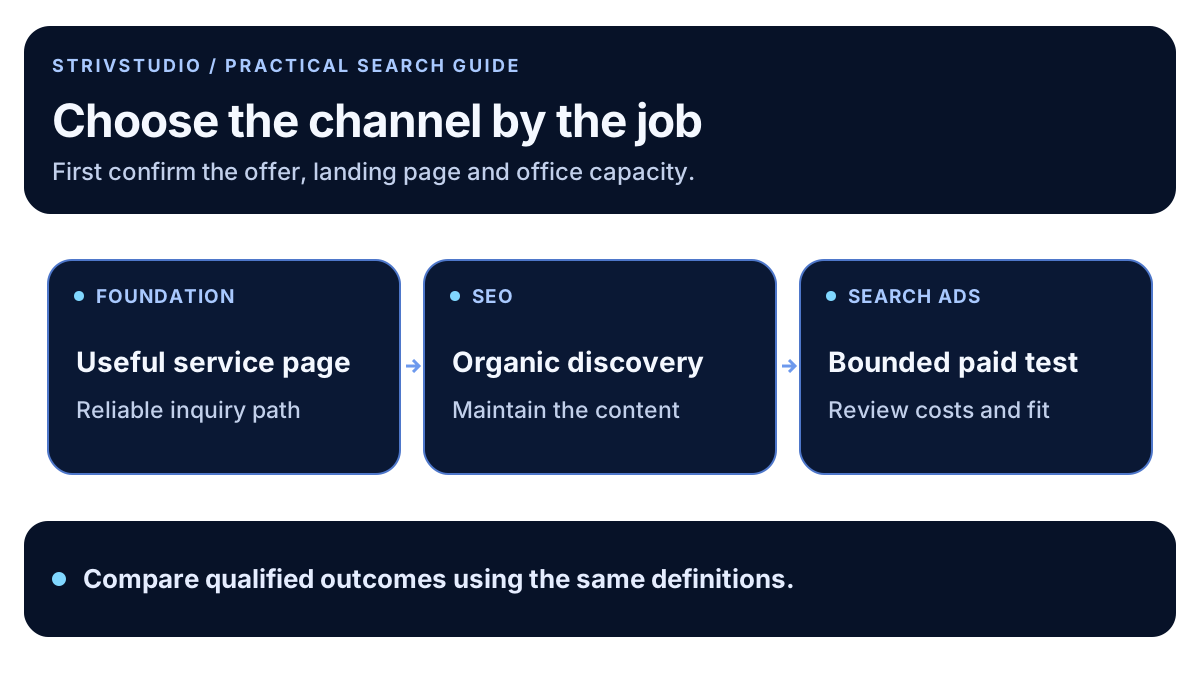
- SEO and Google Search Ads solve overlapping discovery needs with different controls.
- Repair unclear services and broken inquiry handling before increasing exposure.
- Budget for actual work and media costs using current market evidence.
- Compare qualified outcomes with consistent definitions rather than headline clicks.
In this article
Choose SEO or Google Ads by the service you want to grow, the time and budget available, and the office's ability to handle suitable inquiries. SEO improves the website and its organic discovery foundations. Google Search Ads buys participation in paid search auctions. Both need a clear offer, useful landing pages and trustworthy measurement.
This guide compares organic SEO with Google Search campaigns, not every advertising format. Our home-service marketing support starts with the business and website gaps so the channel decision follows a usable customer journey rather than a promised cost per lead.
What should be ready before either investment?
Define the service, accepted areas, property types and actual availability. Confirm who handles inquiries and how outcomes are recorded. A contractor with no capacity for a service should not buy more exposure to that offer simply because a search term appears popular.
Review the destination page on a phone. Can the visitor identify the service, understand relevant limitations and reach the office? If the page is unclear or the contact path fails, repair it first. More impressions can make an existing customer-experience problem more expensive.
Write the business objective in practical terms: suitable replacement assessments, recurring accounts or accepted repair appointments. A generic goal of more traffic makes it harder to choose a channel and judge whether the inquiries helped.
How do SEO and Search Ads differ?
| Decision | SEO | Google Search Ads |
|---|---|---|
| Primary work | Useful accessible pages, structure and supporting evidence | Campaign settings, ads, landing pages and ongoing review |
| Exposure controls | Search systems select and rank organic results | Targeting, bids and budgets shape auction participation |
| Cost structure | Content, development, review and maintenance | Media spend plus campaign and website work |
| Useful evidence | Relevant discovery and qualified organic inquiries | Campaign costs and qualified paid inquiries |
Google's paid-and-organic reporting guidance explicitly separates paid investment from organic ranking. Paying for ads does not purchase a better organic position. A good service page may support both channels because it helps the same customer understand the offer.
When is SEO the stronger immediate work priority?
Prioritize website and organic foundations when important services are missing, existing pages are confusing or the structure prevents discovery. That work is useful even before a ranking change can be observed. It also gives the business stable service explanations to use in sales conversations.
Use actual customer questions to plan guides and link them to the relevant offer. Do not publish a large article quota while the main service remains unclear. Our content planning framework helps assign a purpose, evidence and reviewer to each page.
SEO has ongoing costs and uncertain timing. Existing visibility can change with demand, competition and platform behavior. The local SEO timing guide separates controllable delivery milestones from search and business outcomes.
When might a bounded Search Ads test make sense?
A paid test can be useful when the business has an accepted service, a suitable landing page, enough capacity and an approved spend limit. Define what the campaign is intended to learn: whether a particular service and area produce suitable inquiries, for example. Eligibility and active campaigns do not guarantee impressions, clicks or jobs.
Google's spend-management guidance describes average daily budgets and variable daily spend. Understand the current controls before approving a budget. Do not describe an average as a fixed daily invoice or assume a campaign cannot spend without producing a booking.
Use current research for the chosen market. Keyword Planner guidance explains refining ideas by location and other settings. Tool estimates are planning inputs, not a guaranteed price or a forecast of qualified work for this company.
How should the business compare costs?
List the actual cost categories: page repairs, writing, technical work, media spend, campaign management and reporting. Separate setup from ongoing work. Include the office effort needed to assess and follow up on inquiries instead of treating that capacity as unlimited.
Use a written test scope and review point. For paid search, define the spend boundary and what happens when evidence is insufficient or inquiry fit is poor. For SEO, define the page deliverables and how publication and search observations will be reported. Neither proposal should substitute a promised return for a clear scope.
Do not borrow a cost-per-lead number from another trade or city as if it were a quote. If calculating cost per qualified inquiry, state the included cost and the qualification definition. A media-only figure and a fully loaded figure answer different business questions.
Can the channels work together?
Yes, when each has a purpose and the reporting remains clear. An illustrative company might repair its core installation page while testing paid demand for that actual service. Customer questions from suitable inquiries can inform a guide, but the business should still verify the facts before publication.
Watch for repeated contact from the same person and overlap in branded demand. Do not simply add every platform-reported conversion and call the sum new customers. Keep the office's accepted job record as a separate source of outcome evidence.
What should decide the next investment?
Use Search Console for relevant organic discovery and campaign reporting for paid activity. Pair both with consistent office qualification, booking and completion definitions. Record the reporting periods, attribution limits and unknown sources.
Our measurement guide explains those stages. If the offer is wrong, clarify it. If suitable inquiries go unanswered, improve handling. STRIVSTUDIO's home-service marketing service can help turn that evidence into a practical website and search plan.