Key takeaways
- Fix missing service information before using blogs to fill a publishing calendar.
- Assign each article a distinct question, relevant service and usable evidence.
- Collect operational facts and review ownership before the writer starts.
- Schedule maintenance and measurement alongside publication so existing pages stay accurate.
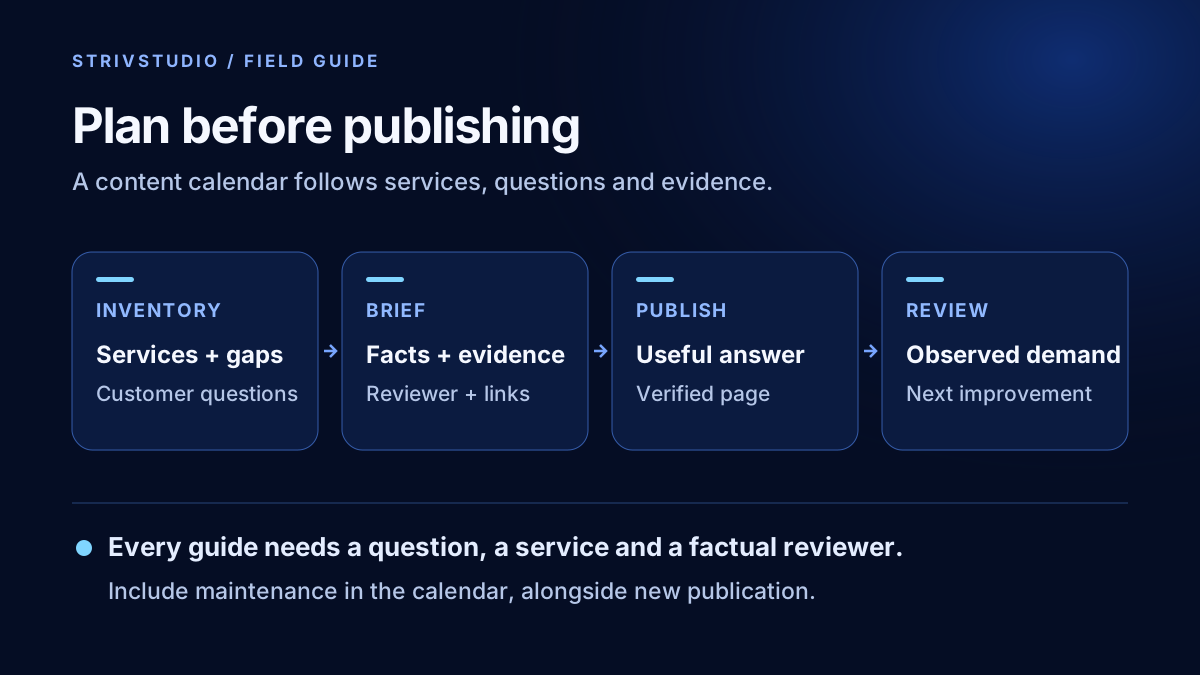
A useful SEO content plan for a home-service business starts with the services you want to sell, the questions customers ask and the evidence your team can provide. Build or repair the main service destinations first. Then publish guides that solve distinct questions, connect them to those services and schedule a review.
The calendar should reflect the office's capacity to supply facts and approve drafts. Publishing more often does not repair an unclear offer or a broken estimate path. STRIVSTUDIO's SEO content writing service starts with the page inventory and brief so each article has a defined job.
What should you inventory before choosing topics?
List the services the company actually offers, the areas it accepts, the jobs it wants more often and the work it turns away. Ask the person handling inquiries where customers misunderstand the scope. A plumbing company that does not handle commercial work should not build a content calendar around those inquiries.
Add the existing website URLs, the question each answers and the service each supports. Review relevant Search Console pages and queries, then mark pages with unclear coverage, outdated facts or no useful next step. Search data can reveal demand already reaching the site; it is not a complete list of every possible customer need.
Keep a short “do not publish” list. It might include unsupported emergency availability, invented local offices, pricing the owner has not approved and technical advice that needs a qualified professional's review. This prevents a writer from filling gaps with assumptions.
How do you turn questions into a topic map?
Group questions by the decision the customer is making. “Do you install heat pumps?” belongs on a relevant service page. “What information should I prepare for a heat-pump estimate?” may deserve a guide. Similar wording does not always mean the same intent, and different wording can still describe one decision.
| Customer need | Page type | Evidence to collect |
|---|---|---|
| Find an AC repair provider | Service page | Actual scope, coverage, contact process and service limitations |
| Prepare for a replacement estimate | Practical guide | Estimator questions and an approved appointment checklist |
| Understand maintenance options | Service explanation or comparison | Current plan terms and what is excluded |
| Confirm whether the company serves a town | Coverage page | Accepted areas and meaningful local details |
Do not attach invented search-volume figures to the map. If a tool supplies estimates, record the tool, market and date and treat the figures as estimates. Use business fit, evidence and existing page gaps alongside demand. Our HVAC SEO guide expands that trade-specific prioritization.
What belongs in a useful article brief?
Give the writer enough verified information to make the article specific. A brief titled “roofing SEO blog, 1,000 words” does not establish what the reader should learn. Write the expected decision first and work backward to the sections and evidence.
- Reader and question: who is asking, and what should they understand afterward?
- Primary destination: the existing page, if any, that owns this intent.
- Business facts: approved scope, limitations, coverage and office process.
- Useful material: interview notes, an anonymized example, diagram or checklist.
- Sources: current primary references for platform rules or external requirements.
- Links: relevant service, supporting guides and existing pages that should link back.
- Review: factual approver, publication date and next maintenance trigger.
Google's helpful-content guidance asks whether material adds original value and satisfies the reader. Use that as a quality check. Do not stretch a complete answer simply to reach an arbitrary article length.
What could a manageable publishing sequence look like?
The following is an example workflow, not a promise of results within a fixed period. Adjust it to the site and the team's ability to review factual content. Finish each item's links and verification before calling it published.
- Foundation: repair the highest-priority service page and confirm coverage and contact handling.
- First guide: answer the most frequent estimate question using an approved office checklist.
- Decision guide: explain a comparison customers struggle with, including limitations and next steps.
- Evidence: publish an approved job explanation or process walkthrough with private details removed.
- Review: inspect page access, relevant discovery data and inquiry quality before extending the plan.
Seasonal content should be ready before the relevant service period, but only claim current hours, offers or program terms when verified. A publishing calendar also needs update slots for an old page that is already useful. New URLs are not the only form of progress.
How should articles connect to money pages?
Give the article a relevant service destination and an appropriate call to action. A preparation checklist can invite the reader to discuss that assessment. It should not promise an estimate for unrelated work or send every reader to a generic homepage.
Add a useful incoming link from the service page or guide hub. Check the relationship in both directions: does the article help explain the service, and can a ready customer find the service from the article? Our internal linking guide includes a repeatable map and audit routine.
Use service-area pages when real local distinctions justify them. Keep a single regional explanation when the content would otherwise repeat. Content architecture should remain understandable to the office that has to maintain it.
What should you review after publication?
Check the public page, mobile reading, headings, sources, links, dates and contact route. Later, compare relevant discovery and inquiry evidence with the dated baseline. Our measurement guide separates search exposure, visits, qualified inquiries and bookings.
At the review, choose a specific action: improve an unclear explanation, supply missing proof, merge competing pages or write the next unanswered question. Keep the reason with the content inventory. STRIVSTUDIO can turn that inventory into a scoped writing and maintenance plan that the business can approve and sustain.