Key takeaways
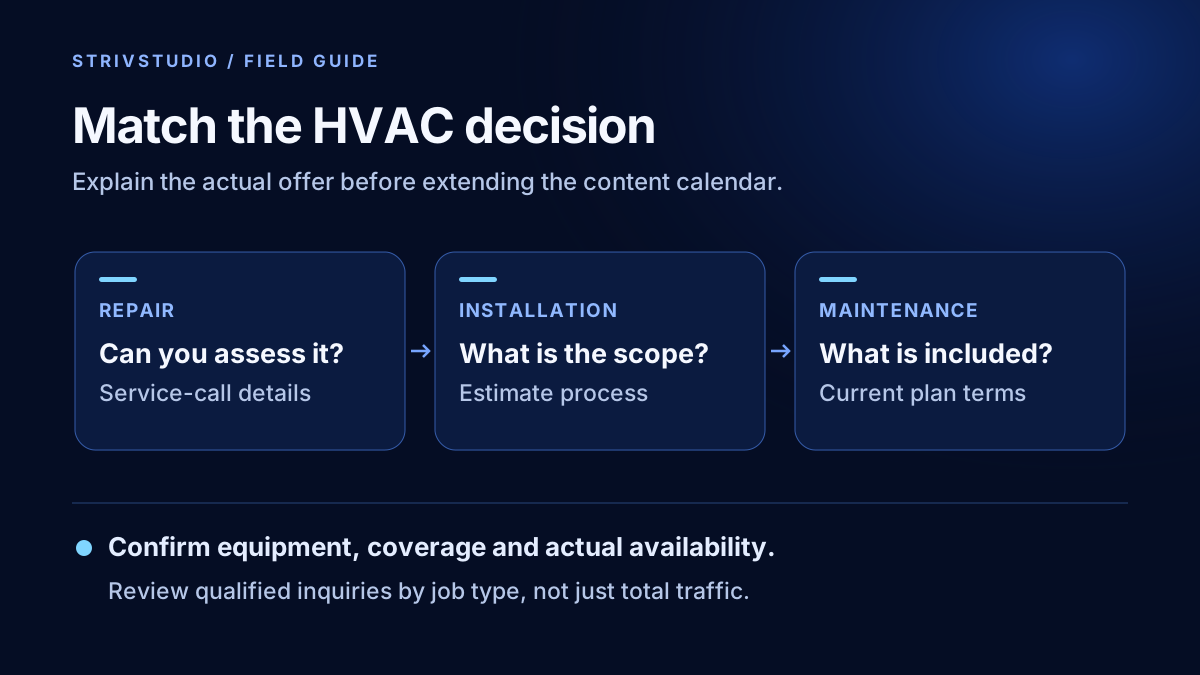
- Separate repair, installation and maintenance when they are real distinct offers.
- Match coverage and emergency claims to what the office can actually support.
- Collect estimator and technician input for useful seasonal and comparison guides.
- Measure qualified service calls by job type alongside discovery data.
In this article
- 1Which service calls should the plan support?
- 2What does a useful HVAC service page include?
- 3How do profile details and availability affect the plan?
- 4How should an HVAC company handle nearby towns?
- 5Which HVAC articles are worth writing?
- 6How does the same content support AI search?
- 7What should the monthly review show?
HVAC SEO starts with clear pages for the services you actually provide, accurate coverage and a website that helps the office receive suitable inquiries. Separate repair, installation and maintenance decisions, support them with useful guides and measure outcomes by job type. A rise in generic traffic is not enough to judge whether the plan is working.
Before commissioning content, confirm the equipment, property types and areas the company accepts. Our HVAC SEO service uses that inventory to prioritize page work. The HVAC website checklist covers the broader customer-facing website review.
Which service calls should the plan support?
Ask the office to list the work it wants more often and the inquiries it declines. A residential company may not service commercial refrigeration. A replacement team may have capacity for assessments but limited repair availability. Those differences should shape the language before a writer chooses keywords.
Build an intent sheet with service, equipment type, property type, accepted area, customer question and existing URL. Keep close phrases together when they mean the same job. Distinguish “AC repair” from “AC replacement estimate” because the customer is making a different decision, not because a tool provides two keyword rows.
Choose a primary destination for each real offer. If the site already has a useful page, improve it before adding another competing URL. Review old campaign landing pages too; they can contain outdated hours or offers that still appear in search.
What does a useful HVAC service page include?
| Service | Customer question | Information to confirm |
|---|---|---|
| Repair | Can your team assess this problem? | Supported equipment, coverage, actual hours and what the office needs |
| Installation | What happens during an estimate? | Assessment process, scope factors, proposal and scheduling steps |
| Maintenance | What is included and excluded? | Current plan terms, visit scope and eligibility |
Explain the real process in plain language. For installation, describe what the estimator needs to assess and what the written proposal will clarify. Do not publish universal savings claims, a fixed replacement recommendation or financing terms the business has not approved. Link current program details to the actual provider when applicable.
Use specific calls to action. A repair page can ask the customer to describe the equipment and issue; an installation page can invite an assessment discussion. Make the next step clear without requiring the visitor to diagnose a technical fault themselves.
How do profile details and availability affect the plan?
Check the Business Profile's business identity, categories, phone, coverage and hours against the office's approved facts. Google's business representation guidance calls for accurate real-world representation. Do not add service keywords to the company name or imply staffed locations that do not exist.
Emergency wording deserves an operational check. Does the phone receive calls after hours? Who responds, and what can they promise? If the team only schedules during office hours, the website should explain that. More exposure for an inaccurate availability claim creates a service problem rather than a useful lead.
Our Business Profile support can review consistency. Keep profile and website observations separate: a corrected service description does not prove that Maps visibility changed.
How should an HVAC company handle nearby towns?
Publish a readable coverage hub based on the areas the office accepts. Add a town page when it can explain something useful and verified, such as a distinct branch process, approved local work or a recurring property-related question. Use the service page for detailed scope so each town page does not repeat the entire offer.
Do not invent location-specific building patterns, permit requirements or weather claims to make the copy different. Verify an external requirement with its current primary source and explain who confirms whether it applies. Our service-area page framework provides a decision process for dedicated pages versus a regional explanation.
Which HVAC articles are worth writing?
Start with the questions the office answers before an estimate. Useful subjects include preparing equipment information for a service call, understanding the sections of a replacement proposal and comparing the company's actual maintenance options. Have a qualified team member review technical details and keep the company's process separate from general requirements.
An original estimate checklist can explain why the office asks about equipment, property access and the customer's goals. An approved, anonymized job explanation can show what changed the scope without inventing savings or outcomes. Label any hypothetical comparison as an example.
Plan seasonal material early enough for the team to review it. Check dates and terms before reusing last year's promotion or rebate reference. Our content planning guide includes review ownership and maintenance triggers, so the calendar does not become a collection of expired claims.
How does the same content support AI search?
Give readers direct explanations of the service, process and evidence. Keep important information in public readable text and use headings that describe actual questions. Google's AI-features guidance connects discovery to the normal search foundations; it does not promise selection.
Do not generate a separate article for every imagined wording of an HVAC question. A complete explanation can answer several related questions. Link the guide to its service, show an honest byline and date, and keep the sources current. The AI-search starting guide covers platform access and current owner controls.
What should the monthly review show?
Review repair inquiries, installation assessments and maintenance requests separately. Record area fit, equipment fit, qualification, booking and follow-up outcome in the approved office system. Note capacity and seasonal demand changes next to the discovery data.
Use our local SEO measurement framework to distinguish profile interactions and website events from confirmed business outcomes. If unsuitable calls rise, clarify the scope. If suitable inquiries arrive but go unanswered, review handling before expanding publication. STRIVSTUDIO's HVAC SEO service can help turn that evidence into the next page and content priorities.