Key takeaways
- Record a dated baseline and compare equivalent periods and service groups.
- Keep Business Profile interactions, website Search data and AI impressions distinct.
- A tracked event does not prove that the office received or qualified a lead.
- Use office-confirmed outcomes and consistent definitions to evaluate business value.
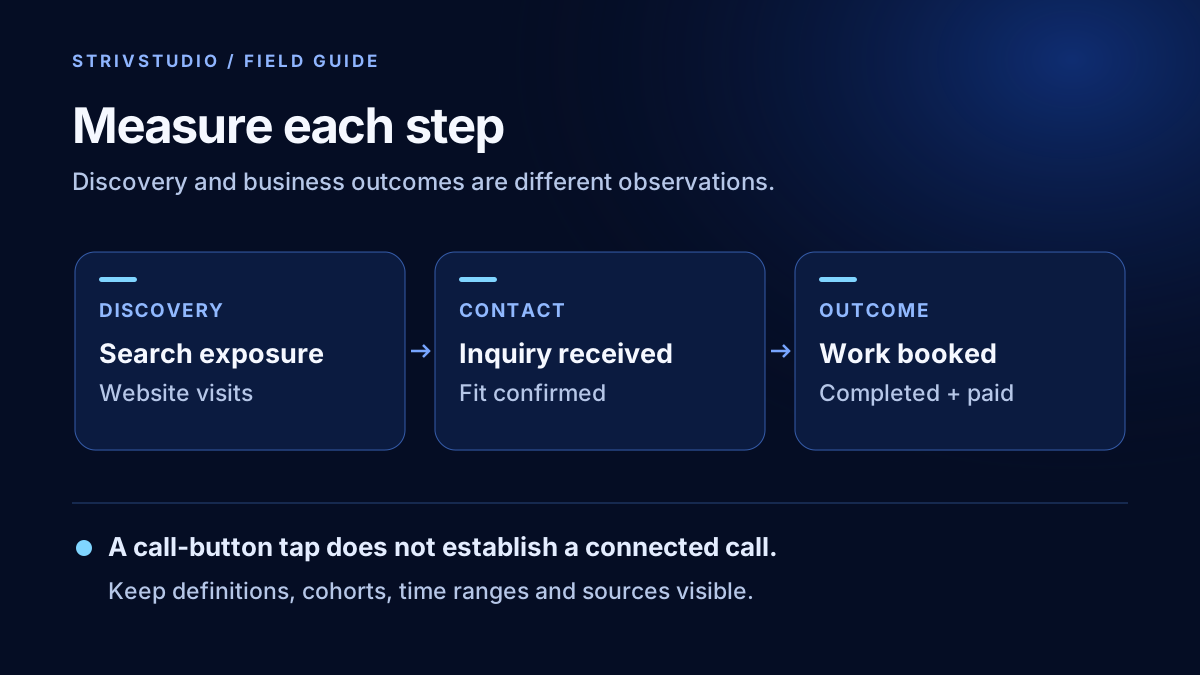
Measure local SEO by separating search exposure, website visits, inquiries, qualified opportunities and booked work. Save a dated baseline, compare equivalent periods and connect website observations with office-confirmed outcomes. Rankings can help diagnose visibility, but they do not show whether the business received the right work.
Use a report someone handling inquiries can challenge and understand. If a metric says “leads,” define exactly what happened and which system recorded it. Our local SEO service connects discovery improvements with a review of the customer's route to contact.
What does each stage actually prove?
| Stage | Example evidence | What it does not establish |
|---|---|---|
| Search exposure | Impression or dated ranking observation | A visit or customer recommendation |
| Website visit | Recorded session or search click | A qualified inquiry |
| Contact action | Call-button tap or form event | Connected call or office receipt |
| Qualified inquiry | Office-confirmed service and area fit | An accepted estimate or booking |
| Booked work | Confirmed job in the operating system | Completed work or collected revenue |
| Completed paid work | Matched completed job and payment record | Profit without cost information |
Write definitions before comparing vendors or months. A form-start event and a booked installation are both useful observations, but calling both a conversion without explanation makes the report misleading. Keep repeat contacts and spam handling consistent.
What belongs in the baseline?
Record the date range, reporting timezone, active services, accepted areas and major website or profile changes. Save the pages and query groups being reviewed. Separate branded searches for the company name from searches for a service, while acknowledging that query data may be incomplete.
Compare like periods where possible: equivalent weekdays, similar seasonal conditions and the same service groups. A hot week can change AC demand, while an office staffing gap can change booking rates. Keep these notes next to the chart instead of treating every change as the effect of a new article.
Export or save the baseline in a format the owner can retain. Record the metric definitions and filters so another reviewer can reproduce the comparison. Do this before a redesign or content batch; recreating the starting point afterward is harder.
How do you separate website search, Maps and AI?
Use Search Console's Search performance report for website clicks, impressions, click-through rate and average position. Keep its query and page filters visible. Average position is an aggregate observation, not a fixed rank every searcher sees.
Use Business Profile performance for the available profile interactions. Google defines Calls as clicks on the profile call button and notes that performance can include organic and Ads activity. Do not label the whole report as verified organic leads.
Google's Generative AI performance report covers impressions in supported Search AI features. The report may not appear without sufficient impressions. Keep its totals separate from clicks and note its aggregation and date settings. These observations are not a cross-platform measure of every AI answer.
For other AI experiences, keep a small repeatable question log with date, platform, context and cited URL. Record referral visits when observable. Our AI-search guide explains why a sampled answer is evidence of that observation, not a universal recommendation.
How should you check inquiry tracking?
Inspect the event configuration and identify its trigger. Does it fire on a button click, a form start, a successful server response or a confirmation-page view? Those events represent different steps. Google's key-event tutorial shows a confirmation-page approach; the business still needs to verify that its chosen trigger matches the intended action.
Check duplicate firing, repeat page visits and what happens after an error. Use an isolated test environment or an explicitly approved test procedure. Do not send surprise test leads into a client's live office workflow. A successful browser interaction alone does not establish CRM receipt, an answered call or successful follow-up.
Ask the office to record service, area, source when known, qualification and outcome. Use approved systems and avoid placing personal customer details in a broadly shared report. Preserve unknown source values rather than assigning them to SEO to make the total look complete.
Which rates are useful?
Use rates only when the numerator and denominator refer to the same cohort and period. Search click-through rate is clicks divided by impressions. An office qualification rate can be qualified inquiries divided by reviewed inquiries. A booking rate should state whether it uses all inquiries, qualified inquiries or completed estimates.
For an illustrative cohort, 20 qualified inquiries from 32 reviewed inquiries gives 62.5%. If eight of those qualified inquiries book, the qualified-inquiry booking rate is 40%. These are arithmetic examples, not benchmarks or STRIVSTUDIO client results. Do not combine one month's new inquiries with bookings from an older cohort and label the result a conversion rate.
What should the review change?
- Exposure but few visits: examine query fit, page presentation and the search context.
- Visits but weak contact action: review service clarity, coverage, evidence and the inquiry path.
- Many unsuitable inquiries: improve scope and exclusions before celebrating volume.
- Qualified inquiries but few bookings: review estimate handling and office follow-up.
- Missing evidence: fix measurement before making a stronger outcome claim.
Turn the finding into a specific page or operational change, then record it in the next baseline. Our content planning framework keeps publishing tied to those decisions. When the website itself is the uncertain part, a technical SEO audit can identify the access, structure and broken-path issues to resolve first.