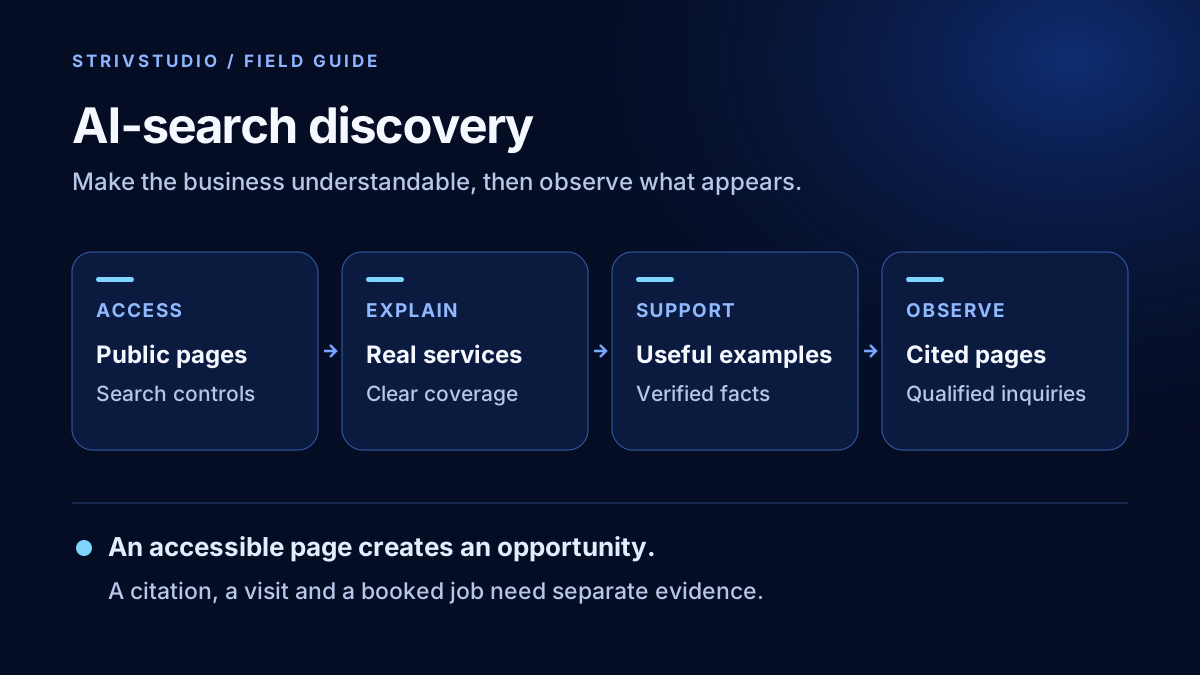
Key takeaways
- Check search access and Google Search Console settings before creating more pages.
- Explain what the business actually does, where it works and how customers can verify it.
- Add useful examples from approved work instead of publishing generic AI summaries.
- Record citations, visits, qualified inquiries and bookings as separate outcomes.
To improve your business's chances of being mentioned in AI search, make your services discoverable, explain them clearly and give readers evidence they can verify. Start with your website and accurate business details, then measure what actually appears. A published page or an allowed crawler is a foundation, not a confirmed recommendation.
For a local contractor, the useful question is specific: can a customer discover the right service in the right area and understand why the company fits? Our AEO, SEO and GEO comparison explains the terminology. The work below turns it into a practical publishing and verification routine.
Which questions should your business answer?
Choose questions from estimate calls, office notes and the services you want to sell. Separate a research question such as “what should an AC replacement estimate include?” from a provider question such as “who installs central air in my town?” The first needs a useful guide; the second needs a clear service page and credible business information.
Make a worksheet with question, intended customer, service, coverage area, existing page and missing evidence. For an illustrative roofer, “repair or replace a leaking roof?” may need an inspection explanation, approved examples of different repair scopes and a link to the repair service. Creating five pages with slightly different versions of that question adds maintenance without necessarily helping the reader.
Can search systems access the information?
Have the developer check the public URL, indexing directives, canonical URL, links and hosting firewall. Test the actual article and service page, not just the homepage. A security challenge or a page that only shows an empty application shell deserves investigation before another content batch.
Google's current generative AI search guidance calls for normal SEO foundations and inclusion in Search generative AI features through Search Console. Review that property setting with the verified owner. Google's Search eligibility also depends on indexing and snippet eligibility; a successful technical check does not prove indexing.
OpenAI's crawler documentation distinguishes OAI-SearchBot for search from GPTBot for training. Review both deliberately. ChatGPT-User handles certain user-triggered visits and is not the control for automatic search crawling. Check infrastructure restrictions as well as robots.txt. If the technical picture is unclear, begin with a technical SEO audit.
What should a service page say?
Give each important service a stable destination that states who it is for, what is included, what affects the scope, where the team works and what happens after contact. Put the essential explanation in readable text. A photograph of a brochure or a heading that says only “Solutions” leaves customers doing unnecessary work.
- Define the service: distinguish AC repair from replacement or seasonal maintenance.
- State boundaries: explain equipment, job types and areas the company actually accepts.
- Show the process: describe assessment, estimate, scheduling and follow-up accurately.
- Offer verification: link relevant credentials or original reviews where appropriate.
- Give a next step: ask for the information the office needs to assess the job.
Keep the business name, contact details and coverage consistent across the website and owned profiles. Explain genuine differences, such as an office address customers cannot visit. Do not create invented offices to make the company appear closer to more towns.
What makes a guide worth referencing?
Add information your team can stand behind. Interview the estimator about a recurring misunderstanding. Turn an approved, anonymized job into an explanation of the decision: what the customer needed, what the crew assessed and what changed the scope. Label hypothetical examples so they cannot be mistaken for results.
A useful article might compare two estimate scopes line by line, show which questions remain unanswered and explain what a homeowner should confirm. That is more helpful than repeating that quality service matters. Use original diagrams when they clarify the decision, and describe their meaning in the surrounding text.
Cite primary sources for platform requirements and manufacturer guidance. Keep a record of permission for job photos and customer quotations. Date time-sensitive statements and revisit them when the underlying source changes. Our home-service content planning guide includes a brief that helps collect this material before drafting.
Which AI-search shortcuts should you question?
Google says Search does not use llms.txt as a ranking input and requires no special AI schema. An accurate file can serve another system, but publishing it does not establish search performance. Clear headings and FAQs help people navigate; there is no reason to force every answer into an arbitrary word count.
Also question paid “mention packages” that do not disclose placements, invented awards, fabricated comparisons and claims of privileged access to ranking systems. Google's advice on evaluating SEO providers warns against guaranteed outcomes and supposed internal metrics. Ask to see the actual pages, sources and changes.
How do you know whether the work is helping?
Save a baseline before publication. Record a manageable set of questions, the platform, date, market context, whether search was enabled and the specific cited page. Repeat the same process at a planned review. A single favorable answer is an observation; it is not a stable market-wide ranking.
Use Google's Generative AI performance report for available Search AI impressions. Its absence can reflect insufficient impressions. Keep referral visits and office-confirmed inquiries beside that discovery evidence. Follow our local SEO measurement framework so a citation, a call-button tap and a booked job remain distinguishable.
Prioritize the next change from what is missing: inaccessible pages, unclear services, weak supporting evidence or a broken inquiry path. Our AI-search optimization service brings those checks into one scoped plan, with documented work and measured observations instead of ranking promises.