Key takeaways
- SEO supports discovery and understanding across search experiences.
- AEO emphasizes clear answers; GEO emphasizes usefulness within generative search.
- A service business usually needs a coordinated plan, not three duplicate content programs.
- Buy defined deliverables and measurement, with no guaranteed rankings or citations.
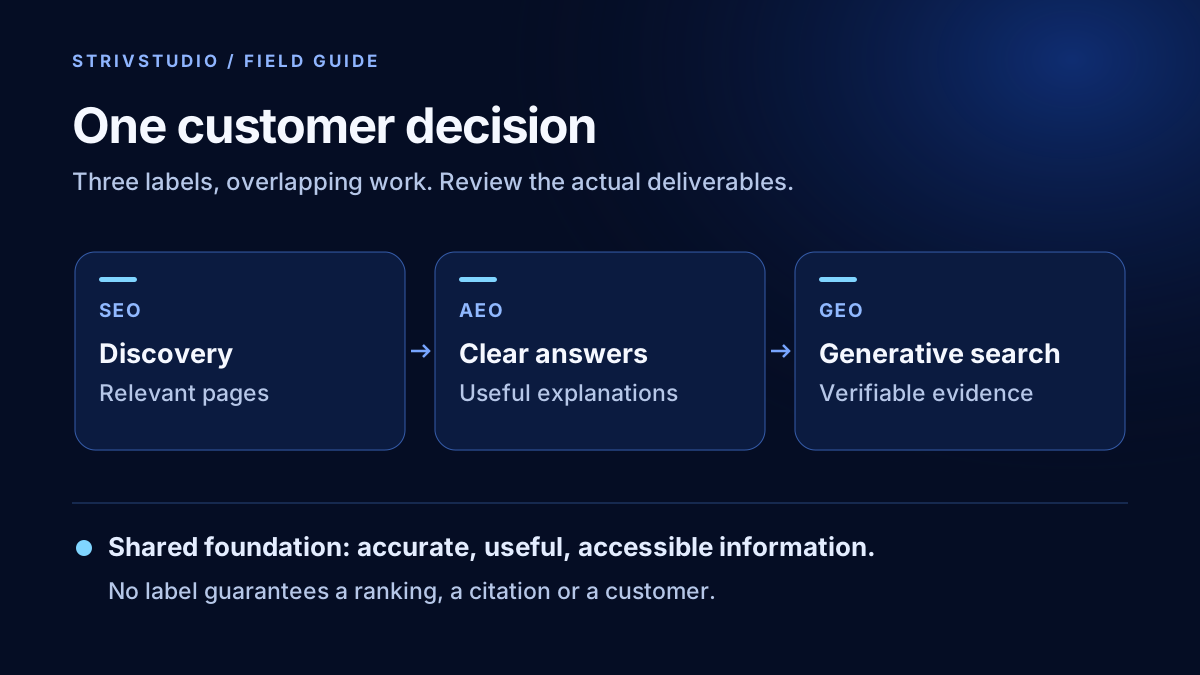
SEO helps search engines and customers discover and understand your website. AEO, or answer engine optimization, emphasizes answering questions clearly. GEO, or generative engine optimization, focuses on visibility in AI-generated search experiences. These labels overlap, so a local business should evaluate the work being proposed and the evidence used to judge it.
A contractor does not need three copies of the same article because a proposal has three acronyms. The useful starting point is a customer decision: finding a provider, comparing options, understanding a service or requesting an estimate. Our AI-search starting guide explains the practical discovery checks behind those decisions.
How do SEO, AEO and GEO compare?
| Term | Main emphasis | Example deliverable | Evidence to review |
|---|---|---|---|
| SEO | Discovery and relevant search visits | A clear, accessible furnace-repair service page | Indexing, relevant queries, visits and qualified inquiries |
| AEO | Clear answers to customer questions | An estimate explanation with useful questions and answers | Readable answers, accuracy and observed search appearances |
| GEO | Usefulness in generative search experiences | Evidence-backed explanations and consistent business information | Observed citations, supported AI impressions and referral visits |
This table is a planning aid, not a claim that platforms operate three separate ranking systems. Google's generative AI optimization guide describes AEO and GEO as common labels and says optimizing for its generative search experience is still SEO.
Which page does the customer actually need?
Imagine a homeowner deciding whether to repair or replace an aging air conditioner. They may first need an explanation of what an assessment considers. Later they may look for an installer who serves their address. Those are connected decisions, but the pages have different jobs.
The guide should explain the comparison, the limitations of a remote answer and what to ask during an assessment. The installation page should explain the company's service, coverage, process and estimate request. Link them where the reader naturally needs the next step. Our internal linking guide shows how to make those connections without turning every paragraph into a list of services.
Assign close keyword variations to a single strong destination when they describe the same service. Do not create a second page merely to add “AI” to its title. A separate page earns its place by solving a distinct problem with enough useful material.
What work supports all three goals?
Build a site a customer can use from a search landing page. Explain the business and service in plain terms, make contact details easy to verify and keep important pages reachable through ordinary links. Check that the public version contains the article, not just a loading message or a login prompt.
Then inspect the evidence. A real job explanation, an approved process diagram or an honest breakdown of estimate factors helps someone assess the provider. A row of unsupported superlatives does not. Keep the author and publication date clear, and distinguish an illustrative scenario from a documented customer result.
For structured data, Google's Article documentation describes how author, title, images and dates can help it understand article information. Markup must agree with what visitors see. It is not a substitute for the article or a promise of a particular search appearance.
Where do platform-specific checks matter?
Technical settings depend on the platform. Review Google's current Search Console inclusion controls for generative AI features with the verified site owner. For ChatGPT search, OpenAI identifies OAI-SearchBot as the search crawler and treats GPTBot's training purpose separately. A policy decision about training should not be confused with a search-access setting.
A local business also needs accurate owned profiles. A website cannot compensate for the wrong phone number or an office address that misleads visitors. Keep an approved record of the public business facts, and assign someone to review changes when services or coverage shift.
Use a technical SEO audit when access and indexing are uncertain. Use editorial work when the existing page is accessible but does not explain the decision. Diagnose the gap before choosing a package name.
How should you evaluate an AEO or GEO proposal?
Ask the provider to translate each activity into an observable deliverable. “Improve authority” is vague. “Interview the estimator, publish an approved comparison guide and connect it to the installation service” is reviewable. Confirm who supplies factual details, who checks claims and who owns maintenance after publication.
- Request a list of existing pages, proposed additions and the intent for each.
- Ask which technical findings are verified and how they were observed.
- Separate content production, profile work and external placements in the scope.
- Define what counts as a qualified inquiry and who verifies it.
- Agree on a dated baseline and a review schedule before publication.
Google's third-party SEO guidance cautions that tools do not have access to its internal ranking data and cannot guarantee success. A proposal should make uncertainty visible. Ask for the actual source behind claims about mandatory files, perfect answer lengths or guaranteed citations.
What should a small business prioritize first?
Start with the weakest link in the customer journey. If the main service is missing, build that page. If pages are inaccessible or duplicated, repair the structure. If the service is clear but the questions are unanswered, commission a focused guide. If inquiries arrive but nobody tracks their outcomes, fix measurement before making a growth claim.
Our local SEO measurement guide separates discovery from business results. Keep those categories in the proposal and the monthly review. An increase in impressions can be useful evidence, but it should not be relabeled as new customers.
STRIVSTUDIO's SEO and AI-search service connects these decisions in one scope. The aim is a website that explains the business accurately, answers useful questions and supports real inquiries, with evidence for what changed and what remains unverified.