Key takeaways
- Create a location page only when it helps a customer assess real coverage and service.
- Use approved local job details and operational differences instead of swapped city names.
- A service area is not a physical office or a reason to create another Business Profile.
- Review existing page performance and links before merging or redirecting weak pages.
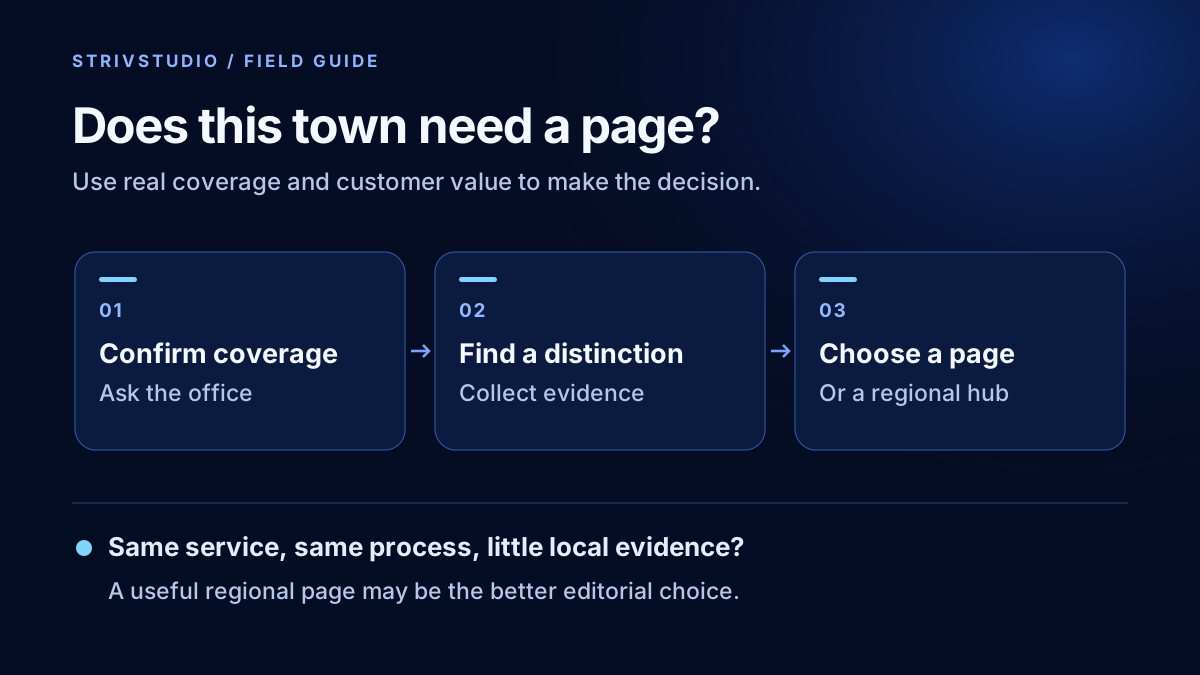
A service-area page deserves its own URL when it helps a customer understand real coverage, a relevant service and a meaningful local consideration. Replacing a town name in otherwise identical copy rarely accomplishes that. Where little changes by location, a well-organized regional page is often the more useful editorial choice.
Start with the places the office actually accepts and the services offered in each. Our local SEO service treats coverage planning as a business decision before a publishing exercise. The right page count follows the information available; it does not come from a list of every nearby ZIP code.
What would this page help a customer decide?
Write one sentence describing the page's job. “Explain apartment-moving coverage in this town, including the access information needed for an estimate” is a usable brief. “Rank for movers plus town” leaves the writer guessing what the customer needs.
For an illustrative contractor, one town may have a genuine showroom and appointment process, while neighboring towns are served by crews traveling from the main office. Explain those distinctions honestly. Do not label a coverage area as an office, imply immediate arrival everywhere or promise a permit process without checking the current local authority.
Google's doorway-abuse policy warns against pages built for similar queries that funnel people toward the usable part of a site. Use that as a reason to review purpose and usefulness, rather than assuming that changing enough words makes a page worthwhile.
When should you publish, combine or skip a town page?
| Situation | Useful next step |
|---|---|
| Real local work and distinct customer questions | Prepare a dedicated page with approved evidence and clear service links. |
| Same service and process across several neighboring towns | Explain coverage on a regional hub with readable town lists. |
| A town the office rarely accepts | Confirm the business decision before adding a marketing promise. |
| Several weak pages already exist | Review data and links, then rewrite or consolidate deliberately. |
This is an editorial framework, not a platform rule requiring one particular hierarchy. A smaller company may need one strong coverage page. A larger operation with genuinely different branches may need several destinations, with each branch's facts verified separately.
What should you collect before writing?
Ask the office and crew for details a generic writer could not safely invent. Collect anonymized job types, the questions customers ask, actual coverage boundaries and approved photos. Record who supplied each fact and when it was checked. A useful example explains what changed the estimate or preparation, not just that the crew visited a town.
- Coverage: accepted service types, scheduling limitations and any genuine exclusions.
- Process: the access, equipment or property information needed before an estimate.
- Evidence: approved job descriptions and photos with private customer details removed.
- Local requirements: a current primary source and a clear explanation of who confirms applicability.
- Next action: the appropriate service page and office contact path.
For example, a moving page can explain that the office asks customers to confirm building access and reservation arrangements. Only describe a particular building's policy as a requirement if it has been verified and is still current. The general question remains useful even when the answer varies by property.
How should you structure the page?
Open by naming the service and the real coverage area. Explain what the team offers, how the process works and what the customer should prepare. Add local examples beside the decision they clarify, then answer the few questions the office actually receives. Finish with a specific route to an estimate.
Link to the central service page for the detailed scope. Do not copy the full service explanation into every town page. Link back from the coverage hub so readers can browse the hierarchy. Our internal linking framework explains these parent, service and guide relationships.
Keep shared facts consistent. The phone number, business identity and operating policies should not become “unique” through arbitrary rewriting. Distinct local value comes from relevant information, not a different adjective for the same crew on every page.
How do website coverage and Google profiles differ?
A website can describe the areas you serve without claiming a separate location in each. Google's service-area guidance distinguishes service-area businesses from hybrid businesses. If customers are not served at the business address, follow its address-display rules.
Use the business representation guidelines when deciding profile eligibility and naming. A new website page is not evidence of a new staffed location. Our Business Profile service reviews those facts alongside coverage content.
How do you repair an existing city-page sprawl?
Inventory every URL, intended service, incoming internal links, search performance and known external links. Mark pages that have useful evidence, pages with a clear purpose but weak writing and pages that repeat another destination. Keep a dated copy of the inventory before changes.
Choose the destination before removing an old page. If two pages answer the same need, consolidate the useful material and plan the appropriate permanent redirect. Update navigation, contextual links, canonical references and sitemap entries. Do not redirect every retired page to the homepage without considering what its visitor wanted.
After release, check the old and new URLs, follow internal links and inspect indexing over time. Use our measurement guide to compare relevant page groups and qualified inquiries. A lower page count can still be the right result when the remaining site is clearer and more useful. STRIVSTUDIO can help plan that work through a technical SEO audit.