Key takeaways
- Separate website delivery from crawling, indexing, visibility and business outcomes.
- Use the site's actual starting condition instead of a universal timeline.
- Diagnose missing evidence before publishing more pages or repeating submissions.
- Compare equivalent periods and record demand, capacity and other changes.
In this article
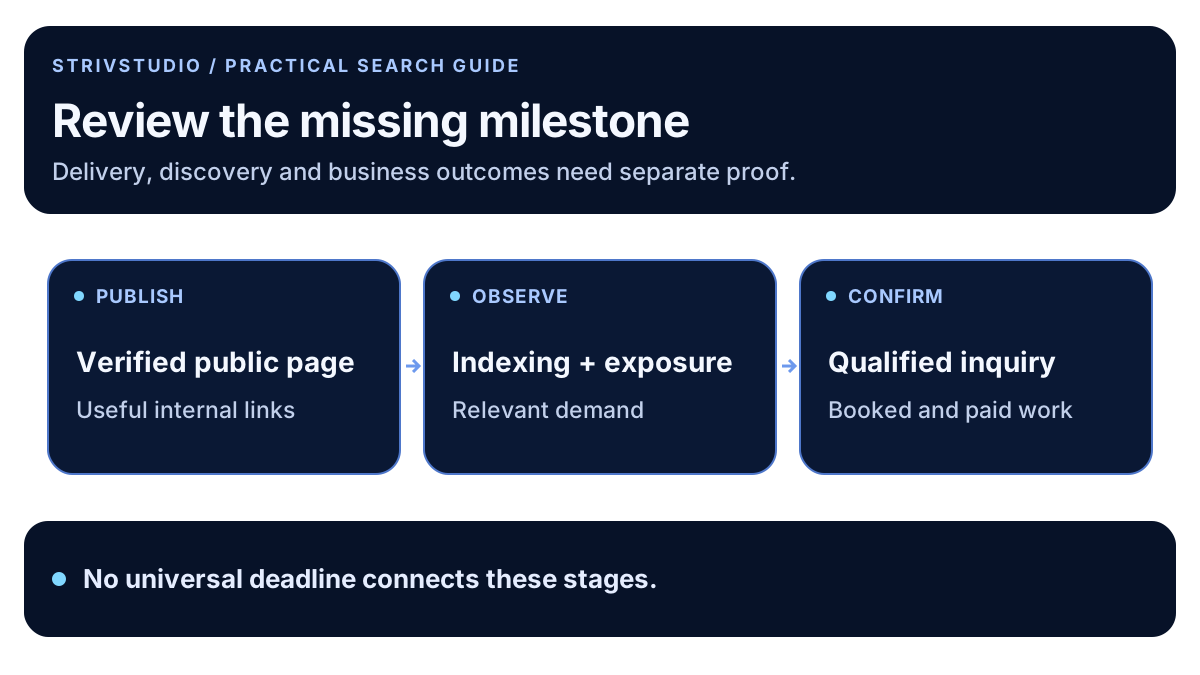
Local SEO has no universal result deadline. The timing depends on the site's starting condition, the changes made, search discovery and the market. Separate work you can verify immediately, such as a corrected service page, from later observations such as indexing, relevant exposure and qualified inquiries. Each needs its own evidence.
Google's SEO Starter Guide says some changes may appear within hours while others can take several months, and not every change produces a noticeable effect. Those broad observations are not a schedule for a particular contractor. Start by identifying the milestone that is actually missing.
What does the starting condition change?
An established site with a clear service page has a different task from a new domain, a broken migration or a business with inaccurate coverage information. Inventory the current public URLs, known search evidence and accepted services before estimating the work.
Ask what “results” means. A page can be deployed correctly without being indexed. An indexed page can receive irrelevant impressions. Suitable inquiries can arrive without becoming booked work. A proposal that combines all these stages into one promised date hides the questions the owner needs answered.
Record a baseline with dates, filters and important changes. If the office has no reliable source labels for inquiries, make that limitation visible. Do not fill the gap by assuming that every new call came from the latest SEO work.
Which milestones should the plan distinguish?
| Milestone | Evidence | Still unproven |
|---|---|---|
| Published | Correct public page, links and metadata | Crawling or indexing |
| Discovered or crawled | Available inspection or crawl observations | Indexing or relevant visibility |
| Indexed | Current verified-property page evidence | Useful ranking or demand |
| Relevant exposure | Appropriate queries, impressions and visits | Qualified inquiries |
| Business outcome | Office-confirmed qualification and job records | Profit without completed work and costs |
Agree on dates for the deliverables the team controls: inventory, approved draft, repair and verification. Keep the search and business observations in a separate review plan. This makes accountability clearer without pretending the agency controls every later decision.
What if the new page has not appeared?
First check the actual public page. Confirm it loads, contains the intended content and is reachable from useful internal links. Review accidental indexing restrictions, conflicting canonical choices and links left pointing to a preview or old destination.
Google's recrawl guidance says a request does not guarantee inclusion and repeated requests do not accelerate the same URL. Inspect the available evidence before resubmitting. A sitemap receipt proves the submission action, not that every listed page was indexed.
Use the verified owner's tools rather than treating a single manual search as complete coverage evidence. Google's Search Console starting guide separates finding and reading pages from performance monitoring. A technical SEO audit can help diagnose the website side when access or structure is uncertain.
What if pages are indexed but useful visibility is weak?
Review whether the page answers the intended customer decision. Does it explain the actual service, accepted area, scope and next step? A long page that avoids the main question may need an editorial repair rather than more sections.
Compare the intended query group with the observed one. An illustrative repair business might attract general how-to research while its service page leaves dispatch coverage unclear. Better matching the offer to the decision is a more focused next step than publishing another generic article.
Check supporting evidence and connections. Approved examples can make a service easier to assess, while useful internal links help readers find the detailed guide or appropriate offer. Our linking framework and content planning guide help prioritize those repairs.
What if Maps and website results differ?
Keep the observations separate. The website and Business Profile have related but different surfaces and reporting. A profile phone correction is a verified information change; it does not itself establish more qualified calls.
Google's Business Profile performance guidance explains available interactions and defines calls as call-button clicks. Check the relevant period and metric rather than treating the report as an office lead ledger. Profile activity can include Ads, so be precise about the claim.
Review actual business facts and accepted coverage when relevant. Do not create invented offices or expand availability promises to make a report look more ambitious. A useful plan improves the information the company can support.
How should review periods be chosen?
Inspect release defects promptly. A broken page or contact path should not wait for a monthly ranking review. For discovery and business outcomes, choose comparable periods with enough observations to assess the question, then note seasonality, staffing, capacity and other campaigns.
A small number of inquiries can move a percentage sharply. Keep the counts beside the rate and avoid attributing a short-term change to one edit when several things changed. The measurement guide explains consistent definitions and cohorts.
If there is insufficient evidence, state that and identify what to collect next. Waiting without a diagnosis is not a plan, but neither is changing every page before the earlier work can be assessed.
When should the plan change?
Change the next action when the evidence identifies a gap: repair access, clarify scope, improve a relevant page, supply missing proof or review office follow-up. If the business needs an additional paid channel, compare readiness and costs through our SEO versus Search Ads guide.
Ask a provider for the completed deliverables, current observations and unresolved questions at each review. STRIVSTUDIO's technical SEO audit service can help establish that starting point and the next reviewable scope without promising a fixed ranking deadline.