Key takeaways
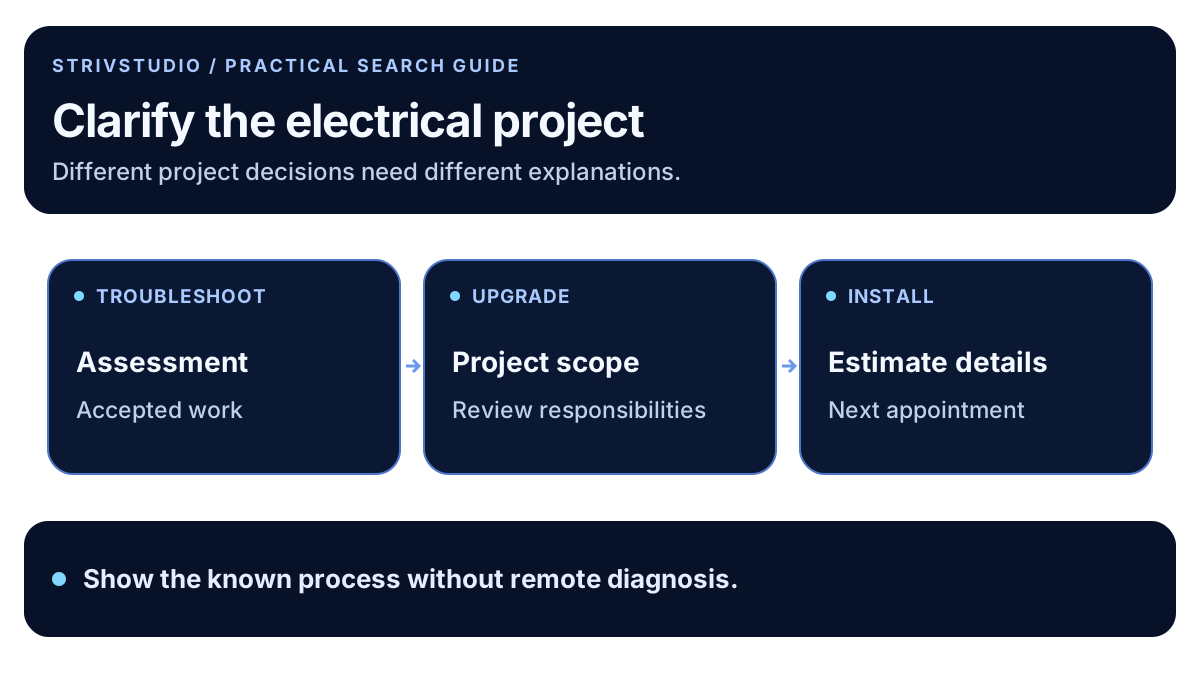
- Separate troubleshooting appointments from upgrades and installation estimates.
- Confirm accepted equipment, property types, coverage and project limitations.
- Explain assessment and proposal questions without remote diagnosis claims.
- Measure qualified projects and bookings separately from website events.
Electrician SEO should help customers identify the electrical work your team actually accepts and prepare the information needed for an assessment. Organize troubleshooting, planned upgrades and installations around their different project questions. Combine accurate local coverage, useful evidence and office-confirmed outcomes so the plan supports suitable work.
The first decision is scope, not a list of keywords. Our electrician SEO service connects the service inventory with page structure and inquiry handling. A focused website can explain a complex offer without implying that it can diagnose a property or approve a project remotely.
What should the service inventory establish?
Ask the estimator which jobs the company accepts, which equipment or systems it supports and which property types it serves. A residential contractor may not accept industrial work. A team that installs charging equipment may require an assessment before discussing the installation scope. These distinctions should be visible before a visitor contacts the office.
Record the service, customer question, accepted area, project limitations and existing URL. Include the questions that slow down estimating: who owns the property, what work is being considered and what access or scheduling information is needed. Have the business approve what it asks customers to provide.
Avoid turning incomplete notes into credential claims. If the company publishes a license, certification or manufacturer relationship, verify the exact current wording and source. A writer should not infer a qualification from a photo of branded equipment.
Which electrical services deserve separate pages?
| Project type | Main customer question | Page emphasis |
|---|---|---|
| Troubleshooting | Can your team assess this issue? | Accepted scope, actual availability and appointment process |
| Planned upgrade | What must be reviewed first? | Assessment, proposal and coordination responsibilities |
| Installation | What information shapes the estimate? | Supported work, site information and next steps |
Combine close variations when one useful page can answer them. Create a new destination when the customer needs materially different information and the team can supply it. Do not publish one page for every synonym of “electrician near me.”
Keep instructions within the page's purpose. Explain what the company assesses and how customers arrange a visit. Technical work instructions need appropriate professional review and should not be invented to make a marketing article longer.
How do you make electrical content specific?
Interview the estimator about a recurring misunderstanding. An original guide might explain what a panel-upgrade proposal should clarify or what property information is useful before discussing an equipment installation. Describe the company's assessment process without assuming the same scope applies to every building.
Use an illustrative comparison to show unanswered questions. One hypothetical proposal may identify coordination responsibilities while another leaves them unclear. The reader can ask for clarification without the article claiming that one unseen contractor is unsafe or that the work will pass an inspection.
Google's helpful-content guidance asks whether an article adds original value and leaves the reader satisfied. An approved process checklist can do that. A generic paragraph about “trusted quality” gives the customer little to use.
How should local coverage be presented?
Publish accepted areas in a readable hub and explain genuine project limitations. Keep office identity and service coverage distinct. Google's service-area guidance describes how businesses that travel to customers should represent their areas and addresses. A town page does not create another eligible office.
Add local pages when the business can explain a meaningful difference, such as a real branch process or approved local project evidence. Do not copy permit requirements from one town into another. Where an external requirement matters, link the current authority and state who confirms applicability.
Our service-area planning guide provides a publish-or-combine framework. When facts are shared across the region, keep them together instead of rewriting the same promise repeatedly.
How should guides and service pages connect?
A guide about preparing for an installation estimate should link to the installation service it supports. The service can link back where a customer needs the detailed preparation explanation. Include the link in the relevant sentence, with a label that describes the destination.
Our internal linking guide shows how hubs, services and articles work together. Check that a visitor can browse from the service inventory to the right explanation and contact route, including on a phone. Avoid placing every service link into every paragraph.
Use an explicit inquiry action: discuss the project, arrange an assessment or confirm coverage. The wording should match what the office will actually do after receiving the request. A form submission should not be described as an automatically confirmed appointment unless that process is real.
How should results guide the next edit?
Use Search Console performance data to review relevant pages and queries. Keep the filters and comparison period visible. Pair those discovery observations with office records for project fit, assessment, proposal and booking.
For example, increasing installation inquiries may be unhelpful if most concern equipment the team does not support. Clarifying that boundary is a sensible next change. If good projects reach the office but proposals stall, review follow-up rather than assuming another article will solve the problem.
The measurement framework keeps those stages distinct. STRIVSTUDIO's electrician SEO service can help prioritize the service explanations, evidence and local structure supported by that review.