Key takeaways
- Separate recurring maintenance, seasonal work and installation project decisions.
- Confirm route coverage and capacity before promoting a new service area.
- Use authentic project evidence with accurate scope and timing captions.
- Review suitable accounts and projects separately from generic website traffic.
In this article
- 1Which work should the website attract?
- 2What should each landscaping page explain?
- 3How can project photos provide useful evidence?
- 4How should route coverage shape local SEO?
- 5What should a landscaping blog help customers decide?
- 6What should happen after the reader is ready?
- 7How do you judge whether the plan fits?
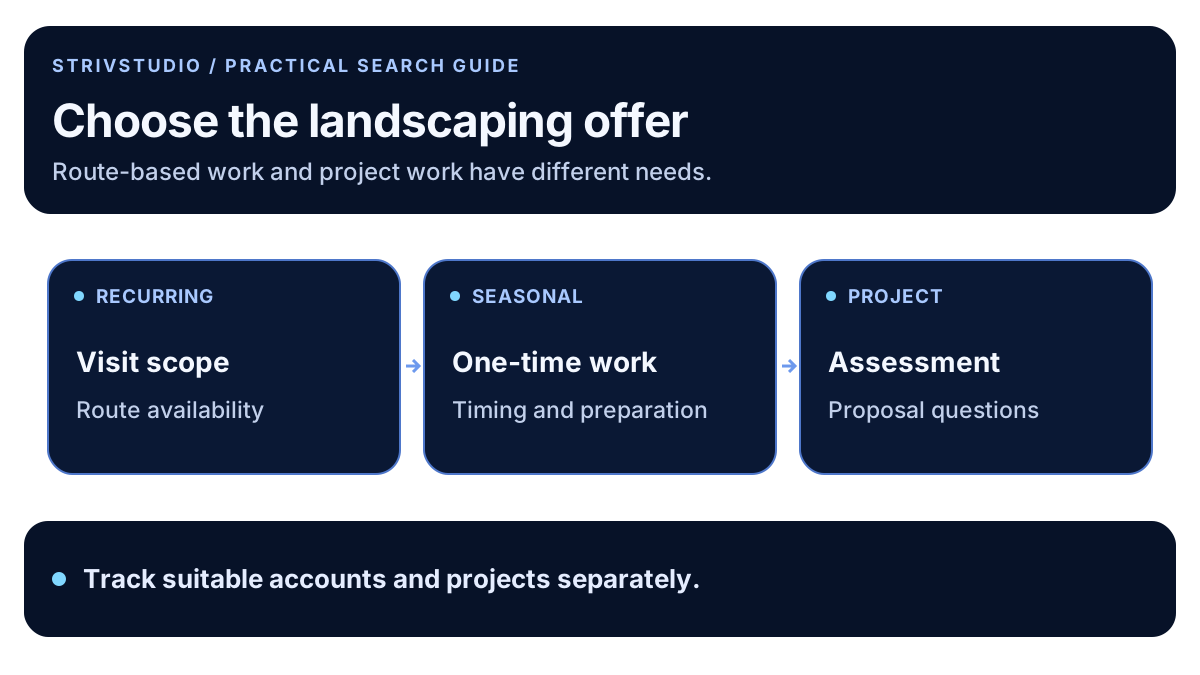
Landscaping SEO should distinguish recurring maintenance from seasonal work and installation projects, because customers need different information for each. Explain what the company accepts, where routes or projects are available and how scope is assessed. Measure suitable accounts and projects alongside search discovery instead of treating every visit as the same opportunity.
A portfolio can attract attention while leaving the offer unclear. Our landscaping SEO service connects project evidence with service pages, coverage and inquiry handling. The plan below helps turn an attractive website into a practical decision tool for a homeowner or property manager.
Which work should the website attract?
Ask the owner to separate recurring work, one-time seasonal jobs and larger projects. Confirm whether the business accepts residential properties, commercial accounts or both. Clarify any work handled by another specialist so the site does not imply that every outdoor service is performed by the same crew.
Record the accepted service, property type, relevant season, area and assessment process. For an illustrative business, a new maintenance account near an existing route may fit differently from a distant one-time cleanup. A design-and-installation inquiry may need a different conversation entirely.
Keep this inventory current as capacity changes. A service that appeared on an old landing page can still attract inquiries after the team stops offering it. Review campaign pages and old articles alongside the main navigation before adding more destinations.
What should each landscaping page explain?
| Offer | Customer decision | Useful explanation |
|---|---|---|
| Recurring maintenance | Does this service fit my property? | Visit scope, exclusions and route availability |
| Seasonal work | What is included in this visit? | Accepted tasks, preparation and scheduling process |
| Installation project | How will the project be assessed? | Consultation, proposal, approvals and scope questions |
Explain the actual inclusions and what needs a separate estimate. Avoid using “full service” as the only scope definition. A customer comparing maintenance options should be able to recognize whether the service includes the work they have in mind.
For projects, describe how the company gathers goals, reviews the site and prepares a proposal. Do not turn an example into a universal completion deadline or promise how plants will perform at every property. Keep product and treatment statements within information the qualified team has reviewed.
How can project photos provide useful evidence?
Use approved photos that show actual work and explain what changed. A caption might distinguish preparation, installation and a later follow-up image. If a picture is a concept rendering, label it clearly rather than presenting it as a completed customer job.
Google's business-photo guidance includes photos of the team at work and emphasizes accurate representation. Apply the same editorial discipline to the website. Retain the original image and permission record, and remove private customer information before publication.
An original project explanation can describe the customer's approved goal and the known scope without claiming unmeasured property-value gains or invented customer praise. Our photo workflow guide provides a practical capture and review process.
How should route coverage shape local SEO?
Confirm where the company actually accepts each service. Maintenance coverage and project coverage may differ. Explain that distinction in the coverage hub so visitors do not assume an installation example means weekly service is available at every nearby address.
Google's local ranking guidance considers relevance, distance and prominence. Adding towns to copy does not create a new operating location or guarantee local visibility. Keep the profile and website aligned with the real business.
Use dedicated service-area pages where meaningful local information exists. Otherwise, a readable regional explanation can support the customer better than many near-identical pages. Ask the office to approve the coverage promise before it becomes public.
What should a landscaping blog help customers decide?
Choose questions from estimate conversations. A maintenance guide can explain how to compare the company's actual visit scope. A project guide can help a customer prepare goals, property information and questions for a consultation. A seasonal article can explain when the office begins accepting requests without promising weather-dependent completion dates.
Collect notes from the person who performs the assessment. Ask what customers frequently omit, which expectations need clarification and which examples can be published. This produces material a generic topic list cannot supply.
The Google SEO Starter Guide emphasizes helping people and search engines understand the site. Use descriptive page titles, clear sections and relevant links to support that purpose. Our content planning guide includes a brief with factual review and maintenance ownership.
What should happen after the reader is ready?
Link each guide to the relevant service. A project-planning article should lead to a project discussion, while a recurring-service explanation should help the customer confirm maintenance availability. Make the inquiry wording describe the actual next step.
Ask only for useful initial information, then explain what the office will review. Do not imply that a submitted request reserves a crew or confirms a final price. Keep public availability and response expectations aligned with the schedule the team can support.
The landscaping website guide and booking-feature checklist cover supporting page details. Use them to review the path from an article to a service and then to contact.
How do you judge whether the plan fits?
Separate new recurring-account inquiries, seasonal jobs and installation projects in office reporting. Track accepted areas, qualification and outcomes. An existing account's later visits are ongoing work, not automatically new customers acquired by that month's SEO.
Compare discovery with these outcomes using the local SEO measurement guide. If inquiries are outside the route or wrong for the crew, clarify the offer. STRIVSTUDIO's landscaping SEO service can help turn those findings into the next service-page and content priorities.