Key takeaways
- Keep your Business Profile consistent with your real business and address setup.
- Choose service and location pages from actual work, not a list of city names.
- Use customer questions and approved job details to make each page useful.
- Review search visibility alongside qualified inquiries and booked moves.
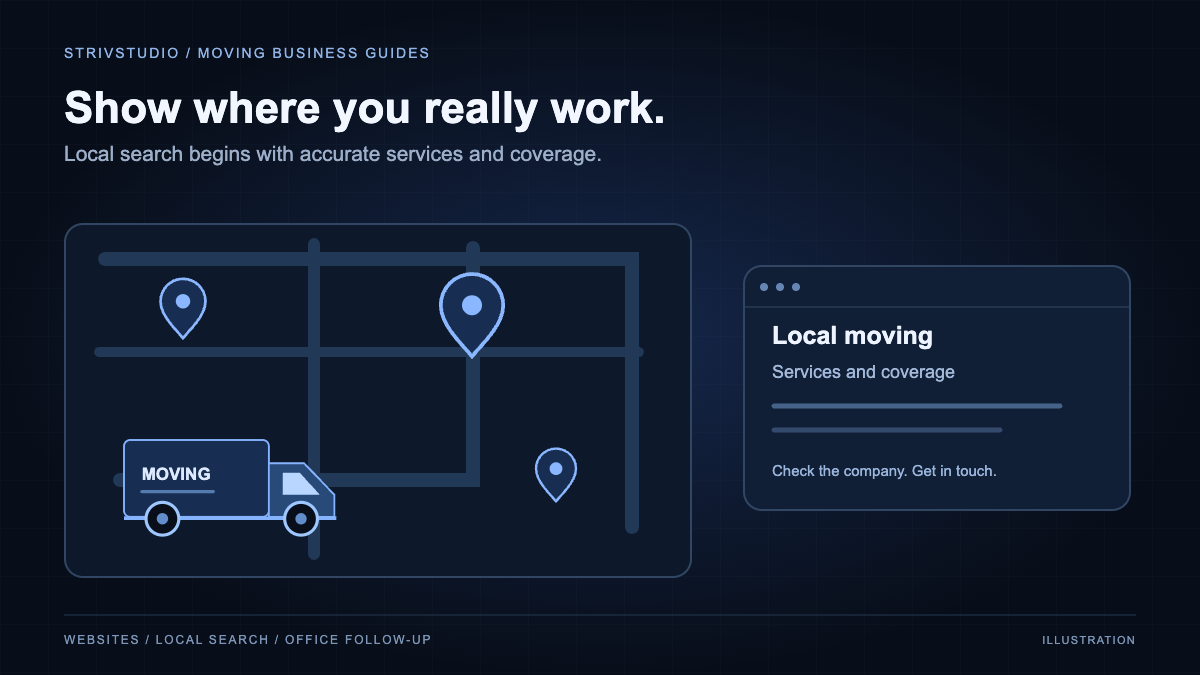
Local SEO for a moving company starts with accurate business information, clear service pages and evidence of the work you do. Before publishing another town page, check whether a customer can find your company, understand your coverage and request the right kind of move.
A useful plan separates Google Maps visibility from the website's search results. Google says its local rankings consider relevance, distance and prominence. A website improvement can support the business's visibility, but it does not move your office closer to every searcher.
Record what you are starting with
Make a short list of the services and areas you want to grow. Ask the office which inquiries it turns away and which jobs it wants more often. Those answers should shape the pages you prioritize. A stream of distant moves is not useful to a crew focused on local apartment jobs.
In Search Console, review the pages and queries already receiving impressions and clicks. Check whether your main service pages are indexed. In Business Profile performance, review the available customer interactions for the same period. Keep the dates beside the figures so the next review compares like with like.
Then connect that view to your office records. Label inquiries by service, pickup area, source when known and outcome. Search data explains discovery; office records show whether the resulting work fits the business.
Get the Business Profile basics right
Use the name customers know from your signage and website. Choose categories that describe the business, keep the phone number current and maintain accurate office hours. Google's business representation guidelines prohibit adding unnecessary service and location terms to the business name.
Your address setup also matters. If customers do not visit you at the business address, follow Google's service-area business guidance and hide that address on the profile. A service area describes where you work; it is not a separate office. Do not create a new profile for each town you serve.
Keep a record of the business's approved details and who can update the profile. Review changes with the owner when a phone number, address or business identity is involved. Our Business Profile service covers this work alongside the website.
Build pages around real service decisions
Start with the services customers need to distinguish. Local household moving, packing, office moving and labor-only work may each deserve a page when they are real parts of the business. Explain who the service suits, what is included and what information the office needs to estimate it.
Location pages need their own useful material. For a place you regularly serve, collect approved job photos, relevant customer questions and practical coverage details from the team. Explain what you can confirm about access, building requirements or scheduling. Check rules with the building or local authority before presenting them as requirements.
Google's doorway abuse policy warns against pages created for similar searches that funnel visitors to the same destination. A stack of near-identical city pages is a poor starting plan. Where you have little unique information, a useful regional service-area page is often the better editorial choice.
Use work and reviews the customer can verify
Ask for permission to use job photos and remove private customer details. A clear image of the crew protecting a doorway can help explain your service better than a stock truck photo. Add a caption that says what happened without inventing the location or the customer's experience.
Keep review requests consistent across completed jobs, and ask for honest feedback. Link published review excerpts to their original source. Google's local ranking guidance notes that review volume and positive ratings can help prominence; that is one part of the picture, alongside relevance and distance.
For local relationships, start with organizations you actually work with: a property manager, storage business or community group. If they maintain a useful partner directory, accurate information there can help customers discover you. Avoid describing a paid placement as an earned recommendation.
Write the questions your office answers
Keep a running list of questions from estimate calls. Do customers misunderstand labor-only service? Are they unsure how to prepare a refrigerator, arrange elevator access or pack fragile items? Choose one question and answer it thoroughly, using your company's actual process.
Link the article to the relevant service page and explain when the reader should contact the office. Google's helpful content guidance favors material that serves readers and warns against publishing primarily to capture rankings. The editorial test is simple: would you send this guide to a customer who had already booked?
Review the work in a useful order
Use the moving company keyword worksheet to assign a primary search intent to each page. Close variations should usually share one useful destination. Keep a record of the market, research date and reason to prioritize the work.
First fix inaccurate details and broken estimate paths. Next improve the main service pages. Then add location pages and guides where you have enough real information to help the reader. This order keeps content production tied to a usable website.
At each review, compare the same date ranges and separate branded searches from searches for a moving service. Look at qualified inquiries and bookings beside clicks. If visits rise while suitable inquiries do not, revisit the page and the office follow-up process. Our movers page shows how those pieces fit into one project.
Make the same facts useful in AI search
AEO, or answer engine optimization, starts with answering a question directly. GEO, or generative engine optimization, adds attention to the evidence and business identity that AI search systems can reference. For a mover, useful answers include the areas covered, the services included and the information needed for an estimate.
Put those answers in readable page content, link them to the relevant service and keep business facts consistent. Cite authoritative sources when discussing rules, and distinguish your company's process from an industry requirement. Google's AI search guidance says the same SEO foundations apply and no special AI schema is needed.
Check search-crawler access as part of the technical review. OpenAI distinguishes OAI-SearchBot for search from GPTBot for model training. Training access is not a prerequisite for search eligibility. Crawler access makes discovery possible; it does not prove that a system recommends the company.
Track observed search exposure and referral visits separately from inquiries. Save the question, date and cited URL when reviewing an AI answer, since answers can vary. Our moving company SEO service covers that work alongside the local search plan.