Key takeaways
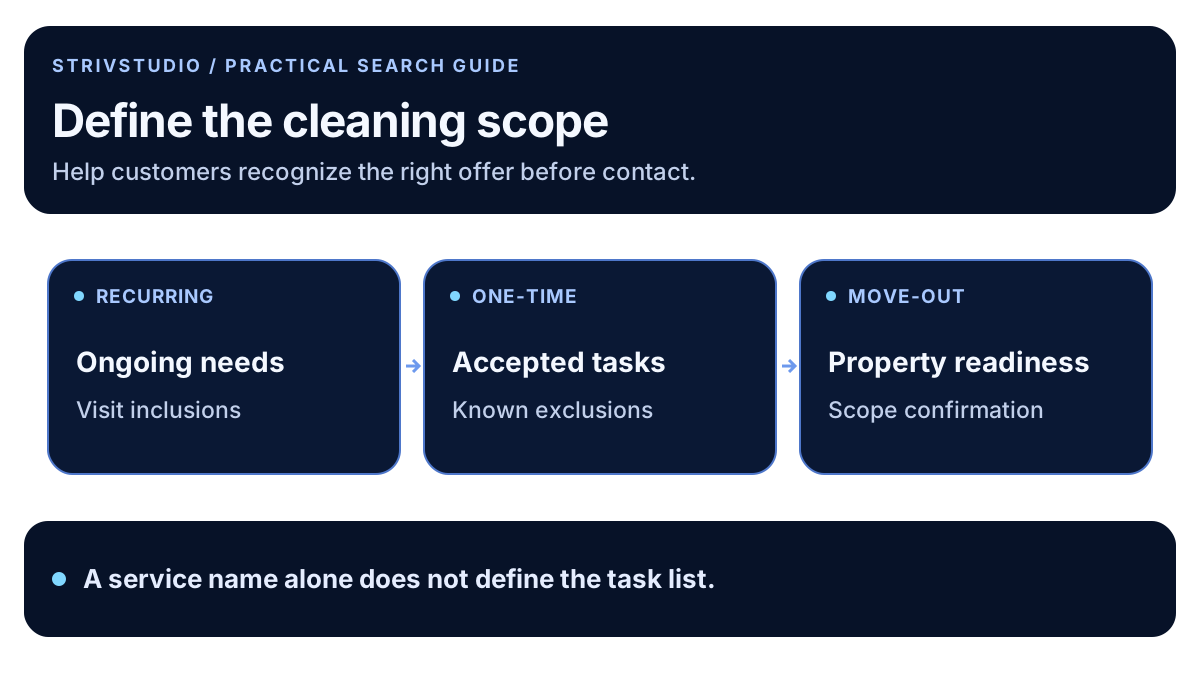
- Define recurring, one-time and move-out cleaning offers with actual inclusions.
- Keep residential and commercial scopes distinct when the business offers both.
- Use authentic evidence without exposing private property or access details.
- Track suitable inquiries and accepted accounts separately from repeat visits.
In this article
- 1What should you confirm before choosing keywords?
- 2How should the main cleaning pages differ?
- 3How do you present local cleaning coverage?
- 4Which articles help a cleaning customer decide?
- 5How do you show proof without overstating it?
- 6How should content lead to the service?
- 7What should the result review distinguish?
Cleaning company SEO should help customers understand the service scope before they request a quote. Explain recurring visits, one-time work and move-out cleaning as distinct decisions when they are actual offers. Match those pages with accurate coverage and an inquiry process that confirms fit, then review accepted work alongside search visibility.
A phrase such as “spotless results” cannot explain what is included. Our cleaning company SEO service starts with the accepted work and the questions the office needs to answer. Clear boundaries help a visitor choose the right service instead of discovering exclusions after an inquiry.
What should you confirm before choosing keywords?
List the company's actual offers, property types and coverage. Separate residential cleaning from commercial accounts if both are available. Identify work that is excluded, referred elsewhere or quoted only after an assessment. Do not assume that a broad category name establishes every cleaning specialty.
Ask the office what creates unsuitable inquiries. It might be an area outside the route, a requested task the team does not perform or a scheduling expectation the business cannot meet. Turn those patterns into useful service explanations rather than collecting more generic traffic.
Keep operational promises precise. If the company publishes statements about staffing, supplies, insurance, background checks or service guarantees, verify the actual current terms. The writer should not infer these details from common industry language.
How should the main cleaning pages differ?
| Offer | Decision to explain | Useful details |
|---|---|---|
| Recurring visits | Does this match ongoing needs? | Visit scope, frequency options and change process |
| One-time cleaning | What is included in this booking? | Task list, exclusions and assessment questions |
| Move-out work | What condition and access are expected? | Property readiness and scope confirmation |
| Commercial account | How is the service assessed? | Site review, scheduling and proposal responsibilities |
Define the terms the business actually uses. “Deep cleaning” can mean different things to different readers, so explain the task scope and any conditions. If appliance interiors or other additions require a separate agreement, state that accurately without inventing a standard market price.
Describe the next step: request information, discuss the property or arrange an assessment. Do not call a form submission a confirmed booking unless the system and office process genuinely establish one.
How do you present local cleaning coverage?
Confirm where each offer is accepted. A recurring route and a one-time project area may differ. Put those facts in a coverage hub and explain meaningful limitations before the customer submits an inquiry. A long list of nearby towns should not imply guaranteed availability.
Google's service-area guidance distinguishes a business that travels to customers from one that also serves customers at its address. Follow the appropriate representation. A website town page does not establish a new staffed office.
Keep the business name and public details accurate under Google's representation guidelines. Our service-area planning guide helps decide when a local page adds enough useful information to justify maintaining it.
Which articles help a cleaning customer decide?
Use questions from quote conversations. A recurring-service guide can help a customer compare the company's actual scope. A move-out preparation guide can explain the property information the office needs. A commercial guide can clarify what is discussed during a site assessment.
Make the examples useful and explicit. In an illustrative comparison, one request might involve an occupied home and another an empty property. Show which questions remain to be confirmed without pretending that all companies define those services identically.
Google's helpful-content guidance asks for substantive reader value. An approved checklist from the team can supply it. Our content planning guide includes the factual reviewer, source material and service destination in each brief.
How do you show proof without overstating it?
Use authentic images and approved descriptions. Before publishing, inspect photos for private documents, people, valuables, address details and access information. Keep the original and permission record. Do not present a staged or generated room as evidence of a completed client clean.
Describe only what the image establishes. A tidy room does not prove a particular sanitation outcome, and a close-up does not establish the full property scope. If a claim needs a product specification or qualified review, obtain it rather than adding unsupported technical language.
Use genuine review excerpts with an original source link where appropriate. Our review strategy guide explains neutral requests and policy limits. The photo guide provides a capture-and-review workflow that can be adapted to approved cleaning material.
How should content lead to the service?
Link a move-out guide to the move-out service and a recurring comparison to the recurring offer. Make the link label explain the destination. A general contact section can support the journey, but it should not replace the specific service explanation.
Check the page on a phone and read it without the images. Can the visitor understand the scope, confirm coverage and find a next step? Our internal linking guide helps connect service pages, coverage and useful articles without forcing a list of unrelated links.
What should the result review distinguish?
Record new recurring-account inquiries, accepted accounts, one-time bookings and subsequent visits separately. Review why inquiries were unsuitable and note route capacity. Repeated visits from one accepted account should not inflate the count of new customers attributed to search.
The local SEO measurement framework separates exposure, contact actions and verified outcomes. Use it to choose the next improvement: clearer inclusions, better coverage information or a missing guide. STRIVSTUDIO's cleaning company SEO service can help plan that work around the business's actual offer.