Key takeaways
- Organize roofing content around real repair, replacement and material decisions.
- Explain assessment and estimate scope without diagnosing a property remotely.
- Use approved job evidence and precise, current credential and warranty statements.
- Track inquiry fit and estimate outcomes alongside search and profile observations.
In this article
- 1Which roofing decisions need different pages?
- 2How can estimate content help before a sales call?
- 3What proof should appear near the service?
- 4How should local coverage and profiles be organized?
- 5How should storm and seasonal topics be handled?
- 6What should be clear for search and AI answers?
- 7What should the roofing SEO report show?
Roofing SEO works best when the website explains the jobs the company actually accepts, the areas it serves and how a homeowner can arrange the right assessment. Build clear repair and replacement destinations, support them with honest evidence and useful estimate guides, and measure inquiry quality alongside search visibility.
Do not begin with hundreds of town and material combinations. First confirm the business's scope: residential or commercial work, supported roof systems, repairs versus replacement and real dispatch coverage. Our roofing SEO service uses those facts to plan a structure the office can maintain.
Which roofing decisions need different pages?
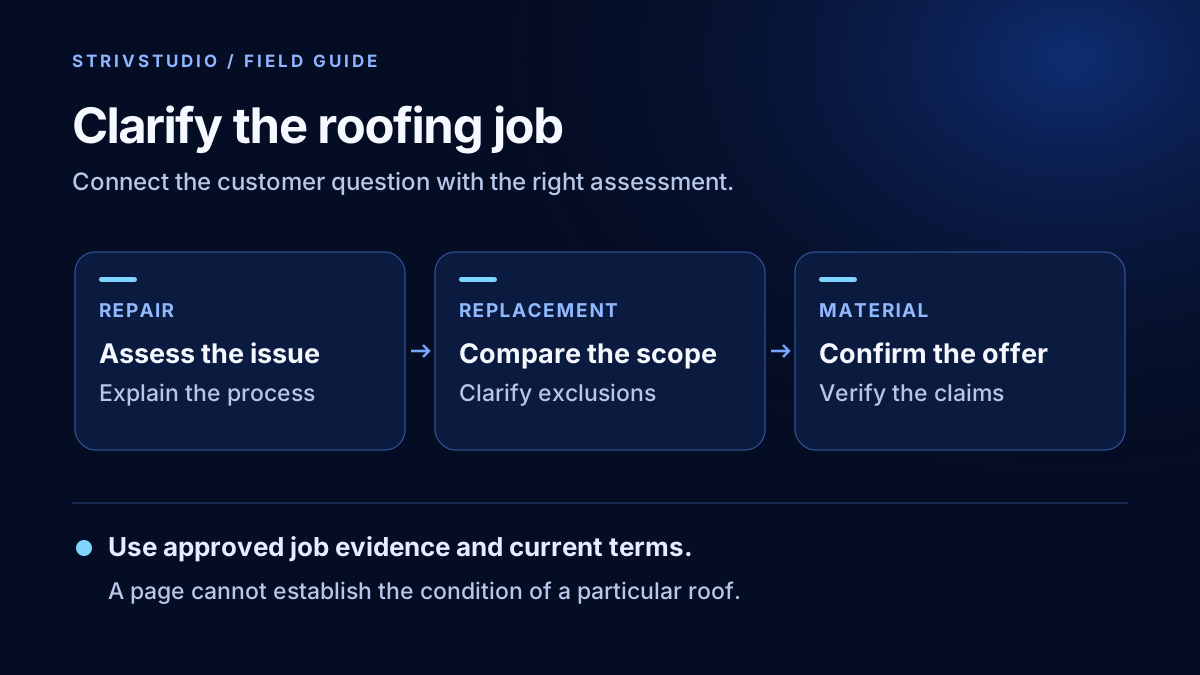
A homeowner asking about a leak is at a different point from someone comparing complete replacement proposals. The repair page should explain the assessment process and the information needed to discuss the problem. The replacement page should explain how scope is established and what the customer can expect from a proposal.
Material pages can be useful when the business genuinely offers those systems and can explain relevant suitability, installation scope and limitations. Do not create a page for a material the crew does not install just because a keyword tool lists it. Review manufacturer and credential wording before naming a certification or special status.
| Customer question | Destination | Useful detail |
|---|---|---|
| Can someone assess this leak? | Roof-repair service | Coverage, assessment process and contact information to prepare |
| What does replacement involve? | Roof-replacement service | Scope, proposal, scheduling and site preparation |
| Why are these estimates different? | Estimate-comparison guide | Questions about inclusions, exclusions and unresolved assumptions |
| Do you work in my town? | Coverage hub or useful local page | Actual accepted area and verified local evidence |
How can estimate content help before a sales call?
Ask the estimator which omissions cause the most confusion. A useful guide can help the homeowner compare the scope described in two proposals, note unanswered questions and prepare for a discussion. Explain that a website cannot determine a particular roof's condition or settle every scope question remotely.
Build an illustrative comparison without invented market prices. One proposal might state how disposal and site protection are handled while another leaves those items unclear. The guide can show the customer what to ask without declaring one contractor's unseen work better or promising that a particular repair is appropriate.
Have the business approve its own process and terms. Link external warranty information to the current provider and distinguish the actual warranty types accurately. Do not imply that every job, product or installer receives identical coverage. Keep current evidence behind every published credential.
What proof should appear near the service?
Use approved job photos with a caption that explains what is visible and why it matters. A sequence can show preparation, work and cleanup when it is a true record of the project. Remove customer addresses and other private details unless the customer has specifically authorized their publication.
Describe outcomes narrowly. A photo does not prove long-term performance, and an attractive finished roof does not establish every claim about the installation. Pair images with accurate scope explanations and real source-linked review excerpts. Do not invent a customer's town or words to make a page look more local.
Google's helpful-content guidance encourages original value and trustworthy sourcing. An approved explanation of what changed a job's scope can provide that value without turning the article into an unsupported case study.
How should local coverage and profiles be organized?
Keep the main service pages focused on the service. Put accepted areas in a readable coverage hub, then add dedicated local pages only when you can supply a useful local distinction. A real branch, an approved job explanation or recurring coverage questions may justify one; a changed town name alone does not.
Our service-area planning guide includes a publish, combine or skip framework. Link each useful local page to the relevant service and back to the coverage hub. Do not imply an office or a crew permanently stationed in every town.
Google's local ranking guidance considers relevance, distance and prominence. Keep the Business Profile accurate and review the factors within the business's control. Adding more town pages cannot move the actual business closer to every searcher.
How should storm and seasonal topics be handled?
Use a seasonal article when it answers a real customer question and the company can fulfill the related service. Confirm actual availability and coverage before publishing urgent calls to action. Do not imply that a specific property has damage or that an insurance claim will be approved.
If discussing a local rule, a manufacturer requirement or another external condition, use its current primary source and identify who confirms applicability. Avoid copying a neighboring town's requirements into a new page. Where the facts are not available, ask a useful preparation question instead of filling the gap with a claim.
The home-service content planning guide includes factual review ownership and maintenance triggers. Use them for promotions, product claims and time-sensitive storm information so old content does not become a misleading current promise.
What should be clear for search and AI answers?
Give each page a direct opening, descriptive headings, readable evidence and a relevant next step. Explain the service and limits in the body, not only in an image or a sales slogan. Keep business facts consistent across the site and owned profiles.
Connect a comparison guide to the relevant service and link useful supporting explanations from that service. Our internal linking map explains these relationships. For platform access and current search-owner controls, use the AI-search guide. Accessible, well-supported information creates eligibility and usefulness; it does not guarantee a citation.
What should the roofing SEO report show?
Separate repair inquiries, replacement assessments and commercial requests. Track area fit, scope fit, office response, estimate and booking outcomes in the business's approved records. Note storm demand and capacity changes beside search observations so a short-term spike is not mistaken for a durable improvement.
Use our measurement framework to keep exposure and contact events distinct from qualified work. If the wrong jobs dominate, clarify the service before buying more content. STRIVSTUDIO's roofing SEO service can turn those findings into a prioritized page and guide plan.